Monday, September 14, 2009

Biography: Beg, Borrow, Steal: A Writer’s Life by Michael Greenberg

Today in January Magazine’s biography section, contributing editor Diane Leach reviews Beg, Borrow, Steal: A Writer’s Life by Michael Greenberg. Says Leach:
By the time he wrote Hurry Down Sunshine, a memoir of his daughter’s descent into mental illness, Michael Greenberg had been plying his trade, with intermittent success, for over two decades. Sunshine changed all that, catapulting Greenberg to enormous fame. Literature, it seems, is no longer sufficient diversion: we have become a society in love in other people’s suffering. We want the real, the screams and rants, the pills and pains, the hospitalizations and ensuing insurance battles. And Greenberg, who has spent his adult writing life searching out such stories, suddenly had an awful tale crash into his family like a bomb. Voilá.
The full review is here.

Labels: , ,

Monday, August 24, 2009

Review: The Love Children by Marilyn French

Today in January Magazine’s fiction section, contributing editor Diane Leach reviews The Love Children by Marilyn French. Says Leach:
Marilyn French spent the bulk of her writing career beneath the shadow of her magnificent first novel, the semi-autobiographical The Women’s Room. Published in 1977, the book is no less searing today than when it first appeared. And while it afforded French deserved fame, the five works of fiction that followed were uneven, ranging from excellent -- The Bleeding Heart, Her Mother’s Daughter -- to the downright bad: Our Father, My Summer with George. The Love Children, French’s final novel, falls on the weaker end of this mighty woman’s output.

The full review is here.

Labels: ,

Monday, August 17, 2009

Review: Swimming by Nicola Keegan

Today in January Magazine’s fiction section, contributing editor Diane Leach reviews Swimming by Nicola Keegan. Says Leach:
Philomena Ash, of Glenwood, Kansas, is a swimming prodigy. She’s tall and strong, with enormous feet and broad shoulders. Her coaches watch and whisper as she steadily breaks Kansas swim records like bundles of dried twigs. By the time she’s sixteen, the word Olympics is being whispered. But other things are going on.
The full review is here.

Labels: ,

Monday, July 27, 2009

Review: A Happy Marriage by Rafael Yglesias

Today in January Magazine’s fiction section, Diane Leach looks at A Happy Marriage by Rafael Yglesias. Says Leach:
Yglesias’s unabashedly autobiographical novel is an homage to his wife, artist Margaret Joskow, who died of bladder cancer in 2004. By turns heartbreaking, amusing, depressing, and joyous, A Happy Marriage is the evocation not only of the couple’s 27 years together, but of Margaret herself, a vibrant, imperfect, loving woman.

The book shifts between the couple’s first three weeks together, with their amusing if agonizing attempts to negotiate dating’s formalities, and their final three weeks of married life, when Margaret, decimated by cancer, is saying her final goodbyes. The contrast of the healthy, beautiful young Margaret and the bald, shivering shadow enduring horrible suffering is a shattering one, made more poignant by Yglesias’s painful attention to detail.
The full review is here.

Labels: ,

Tuesday, July 07, 2009

Fiction: The Lie by Fredrica Wagman

Today in January Magazine’s fiction section, contributing editor Diane Leach reviews The Lie by Fredrica Wagman. Says Leach:

The Lie opens with 17-year-old Ramona Smollens sitting on a park bench, smoking. Her father, the monstrous Nathan Smollens, has been dead exactly one week.

Ramona is joined by Solomon Columbus, an older man who offers her another cigarette. The two begin talking, with Ramona mesmerized by Columbus’s thick peasant hands, culminating in ten “astonishing penis fingers.” Their conversation continues even as the withering August heat gives way to a torrential rainstorm. The couple talk and smoke through the pelting rain, finally returning to the house where Ramona now lives with her mother, the self-absorbed, obnoxiously rude Trixie. The couple brush off her jeering welcome, working their way to the attic, where they spend four days making love and exchanging confidences.

Written in broken, elliptical prose, bristling with bold print and exclamatory remarks, The Lie is reminiscent of Joyce Carol Oates’s more incantatory, dark works.
The full review is here.

Labels: ,

Wednesday, June 24, 2009

Review: A Short History of Women
by Kate Walbert

Today in January Magazine’s fiction section, Diane Leach looks at A Short History of Women by Kate Walbert. Says Leach:
Dorothy Trevor Townsend is starving herself to death. Her cause is not anorexia, but suffrage. The year is 1914, and though a war is on, the brilliant Townsend is doing her best to make a statement, to be heard of above the horrible din of war. She is willing to die for her cause, heedless of her children, Evelyn and Thomas, of her lover, William Crawford, of her mother, who will be stuck with her orphaned children. Dorothy dies for her cause, and is immortalized on a commerative postage stamp, a burden or honorific to be borne by her descendants.

Author Kate Walbert has created an interleaved narrative of five generations of Townsend women, moving across time from England to San Francisco to New York City. In each era another Townsend finds herself fighting for her place among men.
The full review is here.

Labels: ,

Monday, April 20, 2009

Review: Lark & Termite by Jayne Anne Phillips

Today in January Magazine’s fiction section, contributing editor Diane Leach reviews Lark & Termite by Jayne Anne Phillips. Says Leach:
Read this book slowly. You’ll want to speed up, because you’ll want to know what happens next, but you’ll be making a mistake. Set over three days in Korea, Winfield, West Virginia and Kentucky, Lark & Termite is comprised of slowly unfolding sentences that, for all their southern drawl, are honed down to essentials: the way a stray cat’s underbelly sounds dragging along dead grass, the rattle of freight trains, the muffled sounds of tunnels, the secrets families keep. Read too quickly, and you’ll miss something crucial.
The full review is here.

Labels: ,

Monday, April 13, 2009

Review: The Believers by Zoë Heller

Today in January Magazine’s fiction section, contributing editor Diane Leach reviews The Believers by Zoë Heller. Says Leach:
Heller’s fine novel takes on the Litvinoff family, a tribe of New Yorkers utterly certain in their beliefs until, abruptly, they aren’t.

Patriarch Joel is a famous radical lawyer known for defending controversial individuals, most recently an American Muslim suspected of Al Qaeda ties. Joel, an ardent socialist and judgmental moralist, glories in his outsider status, gleefully scanning the morning papers for disparaging publicity.

Joel’s English-born wife, Audrey, fled her humdrum life as a typist to marry this American hotshot. Shy, overwhelmed by America, she constructed a protective carapace, a sharp-tongued, fiercely leftist character that has hardened into a vicious woman.
The full review is here.

Labels: ,

Monday, March 16, 2009

Review: Will Marry for Food, Sex, and Laundry by Simon Oaks

Today in January Magazine’s non-fiction section, contributing editor Diane Leach reviews Will Marry for Food, Sex, and Laundry by Simon Oaks. Says Leach:
I have no idea what possessed Mr. Oaks to pen his self-help ode to marital bliss. He is not a psychologist, MSW, or therapist of any sort. He is an ex-race car driver, and though he alludes to work many times in his deeply silly book, he never specifies precisely what he does. Perhaps he feels his nine -- nearly ten -- years of marriage qualify him to pen such a manual. Perhaps I feel my 16 years of marriage qualify me to say unkind things. Never mind. Down to specifics.
The full review is here.

Labels: ,

Wednesday, February 25, 2009

Review: The Ten Year Nap by Meg Wolitzer

Today in January Magazine’s fiction section, contributing editor Diane Leach reviews The Ten Year Nap by Meg Wolitzer. Says Leach:
Wolitzer’s terrific novel follows the lives of four women who have left the workforce to raise children. Amy Lamb, Jill Hamlin, Roberta Sokolov and Karen Yip are all talented, highly educated, happily married New Yorkers when their babies arrive. And those babies change everything. Suddenly the twelve-week maternity leave is insufficient; each woman, with varying degrees of remorse and financial security, leaves the workforce to tend her offspring.

Wolitzer’s over arching theme is the arguable failure of Feminism: yes, women can now be nearly anything they wish (glass ceiling notwithstanding), but somehow somebody forgot about childcare. Yes, men are getting better about equal parenting, but the workforce in general is achingly slow to accommodate those women who, at the height of their careers, are also anxiously feeling their biological clocks ticking. So the hot young lawyer/doctor/statistician/artist “drops out.” It’s only temporary, she reassures herself. Besides there is the child, or children, who, when small, demand every waking (and often sleeping) moment.
The full review is here.

Labels: ,

Tuesday, November 25, 2008

Holiday Gift Guide: Novel About My Wife by Emily Perkins

Emily Perkins isn’t widely known in North America, which is a shame, as Novel About My Wife (Bloomsbury), her fourth book, is amazing. Tom Stone, a foundering screenwriter, is trying to piece together what went wrong with his wife Ann, who we know at the outset is dead. We don’t know the how she died, or why, but as this almost gothic story unfolds, it’s impossible to put down until we learn the truth.

Ann is everything Tom is not: a beautiful, unconventional Australian, a talented sculptress with a past she refuses to discuss. Tom, is English and more conservative than he’d like to admit, less fortunate in his field and besotted by his red-headed wife. Their relationship is intensely, almost violently sexual in ways Tom chooses to overlook. He also overlooks the jagged scar on Ann’s upper arm, a past pregnancy (aborted), and her literally insane response to Australian Film Producer John Halliburton, whom Tom is longing to work with.

The couple extends themselves financially, purchasing a large fixer-upper in the seedy London neighborhood of Hackney. Ann becomes pregnant, reason for joy, but she also beings unravelling, certain she is being stalked and that malevolence lurks in their crumbling new home. Even the birth of son Arlo fails to calm her increasing hysteria, leading to an inexorable ending.

Perkins’ takes a wry view of English life, of the young couple scrabbling madly for real estate, the right cars, the properly-kitted-out strollers, drinks in the right bistros. That these couples must live beyond their means, chased by envy, is a matter of course, and many American readers will nod in grim recognition. But it is Perkins’ chilling rendering of Ann, mercurial, moody, ultimately unknowable, that truly frightens. Ann’s fears overwhelm both Tom and the reader, moving a novel of domestic unrest into the realm of true horror: hitting us, literally, where we live.

Labels: , ,

Tuesday, November 04, 2008

Review: The Complete Robuchon: French Home Cooking for the Way We Live Now by Joël Robuchon

Today in January Magazine’s cookbook section, contributing editor Diane Leach reviews The Complete Robuchon: French Home Cooking for the Way We Live Now by Joël Robuchon. Says Leach:
Okay, so I’m a coddled, spoiled, Berkeley tree-hugger type of eater. Not only do my vegetables come from a farm, so does my meat. And though I pay slightly less for farm-driven, high-end organic food than I would at the market, that cheaper price comes at the expense of choice. For this year, tomatoes, corn, and fresh fava beans are a memory. The first acorn squash of the season rests in the fridge, awaiting transformation. Likewise, our monthly meat box offers no lamb or vitello (humanely raised calf), but we’re awash in ground beef, steak and two pounds of ground goat.

In other words, I am hamstrung -- albeit willingly -- by seasonality, a commitment to local eating, and the preparation of nightly meals (which often morph into the next day’s lunch).

Cookbooks, of course, are a tremendous source of creativity when faced with a pound of ground goat. So much the better if that cookbook is French. So it was I welcomed Rubochon’s 832 page missive into the house.

I was in for a few shocks to my delicate ecosystem.
The full review is here.

Labels: ,

Thursday, October 16, 2008

Review: The Book of New Israeli Food by Janna Gur

Today in January Magazine’s cookbook section, contributing editor Diane Leach reviews The Book of New Israeli Food by Janna Gur. Says Leach:
To her credit, Gur doesn’t attempt to delve deeply into the complex cuisines of this tiny country. (For the bible on Jewish cuisine, see Claudia Roden’s magnificent Book of Jewish Food.) Instead, she gives us tastes, with explanations all along the way. For example, I had no idea why the many Israelis I know are all salad freaks. I learned that every meal -- including breakfasts and snacks -- includes some kind of salad, most often chopped cucumber, tomato, onion and garlic. The variations on this “Israeli Salad” are endless. I also learned why the Israelis I know are indifferent to red meat: Israel is not cattle country. Instead, the nation thrives on chicken, turkey and lamb. And eggplant. It’s safe to say Israelis view eggplants the way Americans view potatoes: a foodstuff as essential as water.

The full review is here.

Labels: ,

Tuesday, September 30, 2008

Review: Zen and Now by Mark Richardson

Today in January Magazine’s non-fiction section, contributing editor Diane Leach reviews Zen and Now: On the Trail of Robert Pirsig and the Art of Motorcycle Maintenance by Mark Richardson. Says Leach:
The best possible way to read Richardson’s book is to first re-read Zen and the Art of Motorcycle Maintenance. If you are between 40 and 60, chances are you still have a battered paperback copy around -- perhaps the edition with the blue cover (the one my parents had), the orange cover (mine), or Richardson’s pink one. If you are like many of us, you read the book well over 20 years ago, with intermittent comprehension. If at all possible, go back and reread. You will be amazed at how relevant Pirsig’s book remains. You may even be pleased at how much more you understand about his inquiry into Quality. Broken into layman’s terms, Pirsig felt anything worth doing merited one’s full attention; that even the dullest tasks, when carefully attended to, might well elicit better methods. In Pirsig’s pre-computer, pre-Internet, pre-mobile phone world, technology was already demonized. Pirsig argued that technology itself was not to blame for degraded values. Rather, our use of it -- rather, misuse -- lay at the root of societal disintegration.
In other words, hang up and drive.
The full review is here.

Labels: ,

Tuesday, August 26, 2008

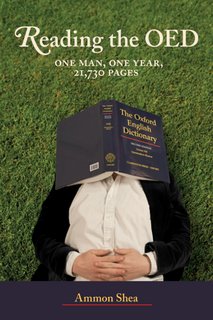
Review: Reading the OED by Ammon Shea

Today in January Magazine’s art & culture section, Diane Leach reviews Reading the OED by Ammon Shea. Says Leach:
I planned to begin by writing that Ammon Shea’s Reading the OED is THE book for word lovers. I ran to look up the word for word lovers (lexiphiles? vocabularians?) but immediately ran into what I always called “the dictionary problem.” That is, if you don’t know the word, or know it but cannot spell it, you’re out of luck. Thanks to Ammon Shea, I now know the technical term for my the dictionary problem is onomonomatia: vexation at having difficulty in finding the right word. If you are true wordarian, or whatever, there is the OED online, which will solve this problem for you via its search engine, provided you are willing to subscribe. Or you may follow Ammon Shea’s example. Wordarian to end all wordarians, Shea read the Oxford English Dictionary cover to cover, the way others might take on Swann’s Way. Caveat Emptor: The Oxford English Dictionary runs 21,730 pages, requiring 20 volumes. The set weighs 137 pounds. Start making shelf space, and working with free weights, now.
The full review is here.

Labels: ,

Tuesday, August 12, 2008

Review: New England White by Stephen L. Carter

Today in January Magazine’s crime fiction section, contributing editor Diane Leach looks at New England White by Stephen L. Carter. Says Leach:
Yale University law professor Stephen L. Carter is obsessed by power, particularly of the backroom variety. In New England White, his thickly layered whodunit (originally published last year, but only recently released in paperback), he pits Julia Veazie Carlyle and her husband, Lemaster, against a shadowy, frightening group out to quell the release of certain information, which has ramifications all the way up to the White House. That the shadowy and powerful are a tiny African-American elite adds a level to this mystery that many others lack: a glimpse into a world rarely seen by whites.
The full review is here.

Labels: ,

Monday, July 28, 2008

Review: The Two Kinds of Decay by Sarah Manguso

Today in January Magazine’s biography section, contributing editor Diane Leach reviews The Two Kinds of Decay by Sarah Manguso. Says Leach:
Sarah Manguso is a poet, and if the beautiful, terse sentences in The Two Kinds of Decay are any indication, she is a fine one. In this short, sharp memoir, Manguso describes the head cold she caught in February 1995. She was 21 years old, in college, second soprano in a choir scheduled to perform Gregorio Allegri’s “Miserere” on March 5, 1995. She managed to keep her cold in check until after the concert, where the choirmaster praised her work. She went home for spring break and began a nightmare of illness that would last for next nine years.

Sarah Manguso has chronic idiopathic demyelinating poliradiculoneuropathy. In layman’s terms, this means her immune system secretes antibodies, which travel to the peripheral neurons, eat away the protective sheath covering the nerve cells -- myelin -- then eat the cells, which sometimes recover, sometimes not. Symptoms include numbness and tingling in the extremities, paralysis, and the inability to breathe.

The full review is here.

Labels: ,

Tuesday, July 15, 2008

Review: Comfort: A Journey Through Grief by Ann Hood

Today in January Magazine’s biography section, contributing editor Diane Leach reviews Comfort: A Journey Through Grief by Ann Hood. Says Leach:
In a world overrun with memoirs, parsing the good from the overwrought, the treacly, or even the completely faked can be nearly impossible. One need only look at the Frey hoopla (surely I wasn’t the only person, way back when, who questioned his claims of Novocain-free dental work?) to know that a genre capable of giving readers so much has taken some dents lately. The garbage, replete with talk show spots and new age affirmations, rises right to the top, while the finer works -- raw, honest, refusing ersatz comforts -- fall from sight, read by only a sleuthing few. Joan Didion’s The Year of Magical Thinking transcended all that, but then again, she’s Didion.

Enough soapbox. Ann Hood’s
Comfort is about the death of her five-year-old daughter, Grace, who contracted a full-body strep infection that killed her in three days. Comfort was excerpted in a book I reviewed a few months ago, Nell Casey’s An Uncertain Inheritance. At the time I wrote:

You have Ann Hood writing about the Strep infection that carried off her daughter Grace in three days. Grace was five. I have no idea where Hood found the strength to write this essay. Be sure you’re at home when you read this one. And make that drink a double.

Indeed, do read this at home -- at 188 pages, it is an evening or two’s reading -- have that drink nearby (Hood drank single malt whiskey, a fine choice), and keep the tissues handy.
The full review is here.

Labels: ,

Monday, June 16, 2008

Review: While They Slept by Kathryn Harrison

Today in January Magazine’s non-fiction section, Diane Leach reviews While They Slept by Kathryn Harrison. Says Leach:

Kathryn Harrison has spent her writing life parsing her difficult childhood. Born to unmarried teenage parents in 1962, the infant Kathryn was “ransomed,” as her mother put it, to her maternal grandparents. Her father was banished. Her mother, openly relieved at recovering her youthful freedom, moved into an apartment and spent little time with her daughter. What time she did spend was fractious, critical and unkind. The appearance of Harrison’s father, when the author was 20, seemed a dream come true: the man adored her. In fact, he couldn’t keep his hands off her. The ensuing incestuous relationship shattered Harrison’s already fragile sense of self. Years later, she documented the episode in her infamous memoir, The Kiss.

The Kiss was followed by the essay collection Seeking Rapture and the wrenching The Mother Knot. In each, Harrison uses her elegant prose style like a scalpel, prising apart the layers of damage in an effort -- seemingly largely successful -- to heal herself. Now happily married to writer Colin Harrison and a devoted mother of three, Harrison has not outrun her demons as much as recognized their destructive capabilities, arming herself for their periodic onslaughts. Yet she retains a grim fascination with dysfunction, murder, trauma. How do people survive? Or not? It is this overarching interest that leads her to the Gilley family.
The full review is here.

Labels: ,

Thursday, May 29, 2008

Review: Around the World in 80 Dinners by Cheryl and Bill Jamison

Today in January Magazine’s biography section, Diane Leach reviews Around the World in 80 Dinners by Cheryl and Bill Jamison. Says Leach:
Cheryl and Bill Jamison are best known for their numerous cookbooks, many focused on grilling and outdoor cookery. As an urban dweller lacking a barbeque, I’d never read much of their work, and looked forward to their travelogue, a jaunt from Bali to Brazil celebrating their 20th anniversary.

I was sorely disappointed. What could be an informative, amusing journey though oft-neglected spots -- been to New Caledonia lately? -- is instead a slog through miserably bad writing interspersed with flat attempts at humor and a more than few trumpetings of the Jamison horn.
The full review is here.

Labels: , ,

.