Tuesday, November 05, 2013

Camus at 100

Albert Camus, the Nobel Prize-winning author, journalist, and philosopher who died in 1960, would have turned 100 on November 7th.

Camus was born in French Algeria in 1913 and died in the Burgandy region of France. Camus’ centenary is being celebrated widely in France. According to Publishing Perspectives, “Books have been published and re-issued and events are ongoing to commemorate one of the country’s preeminent intellectuals. From BD (graphic novels) to a film adapted from one of his short stories (starring Viggo Mortensen) Camus’s body of work provides endless inspiration and food for thought.”
Three years after he won the Nobel Prize for Literature, the French writer and political philosopher, Albert Camus, died in a car accident at age 47 along with his publisher, Michel Gallimard. The unfinished manuscript of what would become his posthumous novel Le Premier Homme (The First Man) was recovered from the wreckage.
The novel was finally published in 1994.

In 1957, Camus was awarded the Nobel Prize for Literature for “his important literary production, which with clear-sighted earnestness illuminates the problems of the human conscience in our times.”

You can see a list of events planned for the centenary here.

Labels:

Monday, October 07, 2013

A Birthday of the Senses

Diane Ackerman was born in Waukegan, Illinois on this date in 1948. Though the author has given the world numerous books over the years, she is best known for 1990’s A Natural History of the Senses. When January Magazine interviewed her several years ago, she said the book has continued to have meaning for many. “People still send me their smell memories,” she said. “Which I like. I’ve become the repository of everybody’s smells.” 

Ackerman’s husband, the poet Paul West, suffered a stroke in 2006. Ackerman subsequently wrote about the experience in the very beautiful One Hundred Names for Love: A Memoir (W.W. Norton) which was subsequently nominated for the Pulitzer Prize.

For her birthday, Writer’s Almanac celebrates some of the author’s accomplishments:
She has a knack for blending science and literary art; she wrote her first book of poetry entirely about astronomy. It was called The Planets: A Cosmic Pastoral, and it was published in 1976, while she was working on her doctorate at Cornell. Carl Sagan served as a technical advisor for the book, and he was also on her dissertation committee. Her most widely read book is 1990's A Natural History of the Senses, which inspired a five-part Nova miniseries, Mystery of the Senses, which she hosted. She even has a molecule named after her: dianeackerone.
In 1970, she married novelist and poet Paul West. They shared a playful obsession with words that was central to their expressions of love for each other. In 2005, Paul suffered a stroke that resulted in global aphasia — an inability to process language — and reduced his vast vocabulary to a single syllable: mem. Even when he recovered the ability to speak, his brain kept substituting wrong words for the right ones, but she encouraged him not to fight his brain, but to just go with it, to say what it was giving him to say. As a result, the hundred little pet names he used to have for her before the stroke have been replaced with non sequiturs like "my little bucket of hair" and "spy elf of the morning hallelujahs." Ackerman wrote about the stroke and Paul's journey back to language in her most recent memoir, One Hundred Words for Love (2011).

Labels:

Keneally’s List

Thomas Keneally, the author best know for his Booker Prize-winning novel Schindler’s Ark, was born on this day in 1935. Schindler’s Ark was published in 1982 “when I still had hair,” Keneally said when January Magazine interviewed him in 1999. The book was later adapted for film by Stephen Spielberg and released as Schindler’s List and would become an Academy Award-winning movie.

On the occasion of Keneally’s birthday, Writer’s Almanac says:
Today is the birthday of Australian author Thomas Keneally (books by this author), born in Sydney in 1935. When he finished school, he decided to become a priest and studied for seven years in preparation. He eventually decided that he wasn't cut out for it, and he left the seminary in 1960, before his ordination. He remains interested in spiritual subjects and social questions. He's written 10 books of nonfiction and many novels; he's best known as the author of Schindler's Ark (1982), the book on which the Steven Spielberg film Schindler's List (1993) was based. It's the story of an opportunistic, alcoholic, womanizing German businessman, Oskar Schindler, who bribed and conned Nazi officials into letting him open his own labor camp staffed by Jewish prisoners. In time, Schindler began to use his labor camp to rescue hundreds of Jews from the concentration camps. Keneally told Publishers Weekly, "Stories of fallen people who stand out against the conditions that their betters succumb to are always fascinating. It was one of those times in history when saints are no good to you and only scoundrels who are pragmatic can save souls."
Keneally’s most recent book is 2012’s The Daughters of Mars, a novel about two Australian sisters who struggle to nurse soldiers badly wounded soldiers during World War I. ◊

Labels:

Wednesday, September 25, 2013

William Faulkner: Just Do It

William Faulker (The Sound and the Fury, As I Lay Dying) who was born on this day in New Albany, Mississippi in 1897, was not only creative in his wonderful writing, he was also deeply creative in his life.

Though Faulkner’s work is strongly associated with the American South, in WWI, he served for Canada. According to Writer’s Almanac, Faulkner added the “U” to his last name when applying for the Royal Canadian Air Force, “believing it made his name look British. Having already been rejected by the U.S. Army Air Corps because of his height of only five feet six inches, he also lied about his birthplace, for good measure, and adopted a phony British accent.”

Faulkner, who died in July of 1962, was awarded the 1949 Nobel Prize for Literature for “his powerful and artistically unique contribution to the modern American novel.” The Nobel contributed to the eventual establishment of the PEN/Faulkner Award for Fiction, a rich prize given annually to the year’s best works of fiction by living American citizens.

In honor of the author’s birth, today The Huffington Post rounds up the author’s six best writing tips.
Though noted for his heavily stylized prose, the writer championed plot over ornate syntax--a strange opinion for a man who once penned a five-word chapter ("My mother is a fish.") According to him, if the story is compelling enough, the style will follow.
It’s worth the trip to find out why Faulkner felt that, among other things, “Writing is not about the author, but the product,” and “The story itself is more important than the style,” and most importantly (and long before Nike ever did) “Just do it.”

Labels:

Friday, August 30, 2013

The Birth of the Mother of a Monster

 Frankenstein author Mary Shelley was born on this day in 1797. According to Writer’s Almanac:
After her marriage to the poet Percy Shelley, the couple went to stay in a lakeside cottage in Switzerland with the poet Lord Byron in the summer of 1816. One rainy night, after reading a German book of ghost stories, Byron suggested that they all write their own horror stories. 
Everyone else wrote a story within the next day, but Mary took almost a week. Finally, she wrote an early version of a story about a scientist who brings a dead body to life. She turned the story into a novel, and Frankenstein was published in 1818. She was 21 years old.
You can see the Writer’s Almanac entry for today here.

Labels:

Val McDermid to Appear at Agatha Christie Festival

Mystery fans in England can look forward to a massive Agatha Christie Festival in Torquay on the English Rivera next month. The festival will begin on September 16, just one day after what would have been the mystery author’s 123rd birthday.

Agatha Christie, the “Queen of Crime” was born in Torquay, not far from where the festival will be held and, according to the festival web site, Christie “spent many of the most important chapters of her life here, as well as using real places in the area as settings for her murder mysteries.”

It is estimated that two billion copies of Christie’s books exist worldwide, representing 80 titles in total.

On the 19th of September, bestselling author Val McDermid will appear at the Festival’s Literary Dinner at Torquay’s Grand Hotel, making this one of the most anticipated events at the 2013 Festival. This appearance comes just in advance of the publication of McDermid’s 27th novel, Cross and Burn.

More information on the Festival and the English Riviera can be seen here.

Labels: ,

Friday, August 16, 2013

Birthday for Bukowski

Poet, novelist and short story writer Charles Bukowski was born in Germany on this day in 1920. The author of six novels, many hundreds of short stories and thousands of poems, in 1986 TIME magazine named Bukowski a “laureate of American lowlife.”

Bukowski’s final novel, Pulp, was completed not long before Bukowski died of leukemia in 1994. The novel was a pastiche of American pulp fiction and a poorly executed mystery that is nonetheless considered to contain some of the author’s sharpest writing and starkest observations.

The author has been the topic of several films, notably the 2003 documentary Bukowski: Born Into This. James Franco is currently working on a film adaptation of Bukowski’s 1982 novel Ham on Rye, which Franco has described as one of his “favorite books of all time.”

Labels: ,

Monday, June 10, 2013

Wild Things Author Celebrated With Google Doodle

Caldecott Medal-winning author, Maurice Sendak, was born on this date in 1928. Polish-born Sendak was best known as the author of Where the Wild Things Are, which was first published in 1963 and has sold some 17 million copies since.

Sendak, who died in May of 2012, is celebrated today with a Google Doodle, making him one of a handful of authors to be honored in this way. 

While we’re talking about the Caldecott Medal, the 2013 winner was This Is Not My Hat, written and illustrated by Jon Klassen and pulished by Candlewick Press.

Labels:

Monday, March 11, 2013

Thanks for All the Fish

Douglas Adams (The Hitchhiker’s Guide to the Galaxy) was born on this day in 1952, an anniversary Google commemorates today with one of their fabulous doodles: this time animated and interactive.

When he died in May of 2001, Adams was an international bestselling author and satirist. But as Writer’s Almanac notes today, that wasn’t always the case:
He was unemployed, depressed, living in his mother's house, when he remembered a night from years before. He was a teenager traveling around Europe with his guidebook The Hitchhiker's Guide to Europe, and that night he was lying in a field in Innsbruck, drunk, looking up at the stars, and he thought somebody should write a hitchhiker's guide to the galaxy as well. 
Adams began with a radio play which chronicled the adventures of everyman Arthur Dent who is onsite when the earth is demolished in an interstellar construction project. Luckily for Arthur, he catches a ride on a spaceship. A hapless hitchhiker and instant radio success for its creator.
In 1978, the radio broadcasts were such a success that Adams turned them into a series of five successful novels: The Hitchhiker's Guide to the Galaxy (1979), The Restaurant at the End of the Universe (1980), Life, the Universe and Everything (1982), So Long, and Thanks for All the Fish (1984), and Mostly Harmless (1992).
See previous Google Doodles here.

Labels:

Thursday, March 07, 2013

American Psycho Author Working on New Novel

Bret Easton Ellis (Less Than Zero, American Psycho) was born in Los Angeles on this day in 1964. From Writer’s Almanac:
His first book, Less Than Zero (1985), was published when he was still a student at Bennington College. He's since written five more novels, most of them about a disaffected, disengaged America. Of course that includes his third, American Psycho (1991), a satirical novel written from the first-person perspective of a Wall Street yuppie serial killer. 
It was banned by the National Organization of Women and dropped by its first publisher. The critic Roger Rosenblatt wrote of it: "American Psycho is the journal Dorian Gray would have written had he been a high school sophomore. But that is unfair to sophomores." Ellis received death threats for it, and the Walt Disney Corporation even barred him from the opening of Euro Disney. The book has since enjoyed a renaissance with critics and scholars.
At the beginning of the year, the 49-year-old author chose a blog to announce that he’s working on a new novel:
The idea to begin a new novel started sometime in January while I was stuck in traffic on the 1-10 merging into Hollywood after I’d spent a week in Palm Springs with the 26-year-old and a friend I’d gone to college with who was now losing her mind.

Labels:

Wednesday, March 06, 2013

Gabriel García Márquez: “Who Taught Me to Write?”

Beloved Colombian writer and Nobel laureate, Gabriel García Márquez, did not take a straight line to become one of the world’s most respected novelists. The author of Love in the Time of Cholera, One Hundred Years of Solitude and others started as a newspaper reporter in the late 1940s and into the 50s.

Márquez honed his craft, working his job every day, “Then, when everyone had gone home for the day, he would stay in the newsroom and write his fiction,” says Writer’s Almanac on the occasion of Márquez’s 86th birthday. “He said, ‘I liked the noise of the Linotype machines, which sounded like rain. If they stopped, and I was left in silence, I wouldn’t be able to work.’”

He learned to write short stories first from Kafka, and later from the American Lost Generation. He said that the first line of Kafka’s Metamorphosis “almost knocked [him] off the bed,” he was so surprised. In one interview, he quoted the first line (“As Gregor Samsa awoke that morning from uneasy drams, he found himself transformed into a gigantic insect”) and told the interviewer, “When I read the line, I thought to myself that I didn’t know anyone was allowed to write things like that. If I had known, I would have started writing a long time ago. So I immediately started writing short stories.”

See today’s Writer’s Almanac here.

Labels:

Tuesday, February 26, 2013

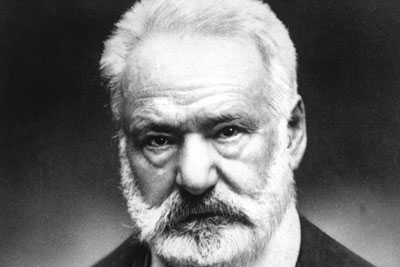
Les Misérables Author, Victor Hugo, Born on this Day in 1802


We wonder what Victor Hugo would have thought of what Hollywood has done with his best-known work, Les Misérables. The novel was published in 1865 and in 2012 was, of course, made into a long and popular movie starring Russel Crowe and Hugh Jackman and which helped Anne Hathaway tuck away an Academy Award for Best Supporting Actress in a brief but riveting role. Victor Hugo, the author of the original work, was born on this day in 1802.

A political activist throughout most of his life, when Napoleon took power in 1851 and established an anti-parliamentary constitution, Hugo went into exile, first in Brussels then in Jersey, where he would stay until 1870.

While in exile, he wrote a great deal, including Les Misérables which, according to The Writer’s Almanac, was “hugely popular, and Hugo returned to Paris, was elected to the Senate of the new Third Republic, and when he died in 1885 at the age of 82, 2 million people showed up to his funeral, a procession through the streets of Paris.”

Hugo’s life makes for some fascinating reading and his 1829 novel, The Last Day of a Condemned Man, is said to have influenced the work of Albert Camus, Charles Dickens and Fyodor Dostoevsky.

Like his deep concern for human rights, Hugo’s work with regards to the rights of artists was both forward-thinking and far-reaching. He was a founding member of the Association Littéraire et Artistique Internationale, which ultimately led to the creation of the Berne Convention for the Protection of Literary and Artistic Works. Hugo notably said that “any work of art has two authors: the people who confusingly feel something, a creator who translates these feelings, and the people again who consecrate his vision of that feeling. When one of the authors dies, the rights should totally be granted back to the other, the people.”

Labels:

Friday, February 22, 2013

Gorey Gets Doodled

Though it’s possible you don’t know Edward Gorey’s name, it’s much less likely that you’re unfamiliar with his style. A surrealist whose work had a strong, commercial appeal, Gorey wrote more than 100 books and illustrated many, many more. From Wikipedia:
Gorey was noted for his fondness for ballet (for many years, he religiously attended all performances of the New York City Ballet), fur coats, tennis shoes, and cats, of which he had many. All figure prominently in his work. His knowledge of literature and films was unusually extensive, and in his interviews, he named Jane Austen, Agatha Christie, Francis Bacon, George Balanchine, Balthus, Louis Feuillade, Ronald Firbank, Lady Murasaki Shikibu, Robert Musil, Yasujirō Ozu, Anthony Trollope, and Johannes Vermeer as some of his favorite artists. Gorey was also an unashamed pop-culture junkie, avidly following soap operas and television comedies like Petticoat Junction and Cheers, and he had particular affection for dark genre series like Buffy the Vampire Slayer, Batman: The Animated Series and The X-Files; he once told an interviewer that he so enjoyed the Batman series that it was influencing the visual style of one of his upcoming books. Gorey treated TV commercials as an art form in themselves, even taping his favorites for later study. Gorey was especially fond of movies, and for a time he wrote regular reviews for the Soho Weekly under the pseudonym Wardore Edgy.
Today what would have been his 88th birthday, Google honors Gorey with one of their Doodles. You can see previous Google Doodles here.

Labels:

Tuesday, February 19, 2013

Copernicus’ Birthday Marked by Google Doodle

Scientist, mathematician, astronomer and author Nicolaus Copernicus was born on this day in 1743. Copernicus’ authorship of De revolutionibus orbium coelestium (On the Revolutions of the Celestial Spheres), contributed greatly to scientific knowledge of the solar system.

The event is marked this year by a fantastic Google Doodle that illustrates Copernicus’ most celebrated achievement: the heliocentric theory that proved the Sun was as the center of the solar system, not Earth. This theory ended the notion that the Sun revolves around the Earth and cemented Copernicus’ position as the founder of modern astronomy.

Labels:

Thursday, January 31, 2013

Birthdays for Lomax, Mailer and O’Hara

I’ve been writing about birthdays with a slow sort of regularity for January Magazine for many years. One of the things that’s struck me about this exercise is the discovery, very early on, that big talent tends to run in clumps.

For instance today, the 31st of January, is the birthday of three writers with very big shoes: Alan Lomax (Cowboy Songs and Frontier Ballads, Songs of the Cattle Trail and Cow Camp) was born on this day in 1915; Norman Mailer (The Naked and the Dead, The Executioner's Song) in 1915 and John O’Hara (Appointment in Samarra, A Rage to Live) in 1905.

Each of this trio are very well known, but if you’d like to know more about them, follow the link from their name.

Labels:

Thursday, January 17, 2013

A Birthday for Brontë

Anne Brontë, the youngest of the famous Brontë sisters, was born in Yorkshire, England, on this day in 1820. According to The Writer’s Almanac:
She was meek and more religious-minded than Charlotte or Emily and little is known about her life compared to the lives of her sisters. As a child, she was closest to Emily, the youngest of her older siblings. Together they played with toys, made up stories about them, and began to write them down. They created an imaginary world called "Gondal," which provided the setting for the first of Anne’s known poems, "Verses by Lady Geralda" (1836) and "Alexander and Zenobia" (1837).
Though less modest of the sisters’ publishing efforts get the most play, Anne poetically participated in an early example of self-publishing. The efforts of the sisters were not well rewarded.
In the summer of 1845, Anne, Emily, and Charlotte found themselves at home together without work. They decided to put together a book of poems they'd written over the past five years. They told no one what they were doing. Anne and Emily each contributed 21 poems and 19 were Charlotte’s. The sisters agreed to publish under pseudonyms and Charlotte arranged publication of The Poems of Currer, Ellis, and Acton Bell through Aylott & Jones, at the authors' expense. The cost of publication was 31 pounds, 10 shillings—about 3/4 of what Anne's annual salary had been as a governess. On May 7, 1846, the first three copies of the book were delivered to the Brontë home. The book received three somewhat favorable reviews and sold a total of two copies.

After the lackluster sales of their book of poems, the talented trio turned their efforts to writing novels. And though Anne would see some success, she was always overshadowed by her older siblings.
The sisters turned to writing novels. Charlotte’s The Professor and Emily’s Wuthering Heights reflected both Gothic and Romantic ideas. Anne was more of a realist and began Agnes Grey—based on her experience as a governess—with the words, “All true histories contain instruction.” 
The three manuscripts made the rounds of London publishers for a year. In the meantime, Charlotte wrote and published Jane Eyre (1847). Two months later, Wuthering Heights and Agnes Grey were published, in December of 1847. Most of the reviewers' attention was given to Wuthering Heights and the wildly successful Jane Eyre.
Still, it was as a novelist that Anne would receive her widest recognition and her second novel, 1848’s The Tenant of Wildfell Hall was a success right out of the gate, though it would also bring controversy.
The heroine, Helen Huntingdon, leaves her husband to protect their young son from his influence. She supports herself and her son by painting while living in hiding. In doing so, she violates social conventions and English law. At the time, a married woman had no independent legal existence apart from her husband. It was later said that the slamming of Helen Huntingdon's bedroom door against her husband reverberated throughout Victorian England. 
In the second printing of The Tenant of Wildfell Hall, Anne Brontë responded to critics who said her portrayal of the husband was graphic and disturbing. She wrote, "Is it better to reveal the snares and pitfalls of life to the young and thoughtless traveller, or to cover them with branches and flowers? O Reader! if there were less of this delicate concealment of facts—this whispering "Peace, peace," when there is no peace, there would be less of sin and misery to the young of both sexes who are left to wring their bitter knowledge from experience."
Anne Brontë died of tuberculosis in May 1849, a year after Emily’s death.  “While on her deathbed,” says Writer’s Almanac, “Anne’s last words, whispered to Charlotte, were, ‘Take courage.’”

The Writer’s Almanac, a terrific resource, is here.

Labels: ,

Monday, December 10, 2012

A Poetic Birthday

In addition to today being the birthday of the very Dewey who organized the library and the anniversary of the day in 1884 when Mark Twain first published The Adventures of Huckleberry Finn, Writer’s Almanac lets us know that it is also the day of birth of a whole lot of poetic power.

Most notable, of course, is the Belle of Amherst, Emily Dickinson, who was born on this date in 1830. From Writer’s Almanac:
She spent most of her adult life in her corner bedroom in her father’s house. The room contained a writing table, a dresser, a Franklin stove, a clock, a ruby decanter, and pictures on the wall of three writers: George Eliot, Elizabeth Barrett Browning, and Thomas Carlyle. Her favorite author was Shakespeare. She eventually wrote more than 1,700 poems. In the year 1862 alone, she wrote 366 poems -- about one per day.
On this date in 1925, Pulitzer Prize-winning Carolyn Kizer was born in Spokane, Washington.
Kizer is unapologetically proud of her ability to perform her own poems, something she has worked very hard at. “Dylan Thomas was a success not because he was a great poet, but because he read magnificently. There are only a couple of women who read well, and I'm one of them. I'm modest about my poetry, but I'm not modest about my reading. I've worked hard to be good at it, and I'm proud of it.”
Another poet, Thomas Lux, was born in Northampton, Massachusetts, on this day in 1946.
“He's known for his surreal, funny poems with titles like “Commercial Leech Farming Today,’ ‘Traveling Exhibition of Torture Instruments,’ ‘The Oxymoron Sisters,’ and ‘Walt Whitman's Brain Dropped on Laboratory Floor.’ 
He describes contemporary American poetry as “Burgeoning, chaotic, many, many good poets, a growing cultural profile, a healthy, squawking, boisterous, fractious, inclusive, tradition and (true) innovation marrying or colliding.”
The Writer’s Almanac piece is here.

Labels: ,

Tuesday, February 07, 2012

A Tale of Three Birthdays

In typically fine form, today, Google celebrates the anniversary of the birth of storyteller supreme, Charles Dickens. Dickens, who would have been 200 today, was the author of A Christmas Carol (1843), Great Expectations (1860-1861), David Copperfield (1849-1850) and many others. Today’s celebrational Google Doodle features some of the better known characters from Dickens’ work, including Ebenezer Scrooge, Oliver Twist and Philip Pirrip.

The Washington Post tell us that many people don’t realize how very famous Dickens was during his lifetime:
“He was so handsome when he visited Boston,” said Diana Archibald, a professor at the University of Massachusetts at Lowell, which is hosting a citywide party today for Dickens. “He had long hair like a woman, and they treated him like a rock star.”
Meanwhile, The London Telegraph points out some of the celebrations taking place today in Dickens’ honor:
Events to be held across the country include a wreath-laying ceremony at Dickens' grave in Poets' Corner, Westminster Abbey, and at his birthplace in Portsmouth, Hampshire.

The congregation at Westminster Abbey will include the largest ever gathering of descendants of the Victorian novelist as well as representatives from the worlds of literature, film, theatre and the media.

Charles will lay a wreath on Dickens' grave where he was buried in 1870.

The author had asked to be buried at Rochester Cathedral but a public outcry led to him being placed in Poets' Corner.

Ralph Fiennes, who will next be seen as Magwitch in a new film adaptation of Great Expectations, will read an extract from Bleak House with readings also being given by Mark Dickens, great-great-grandson of Charles Dickens, and biographer Claire Tomalin.
Meanwhile, Writer’s Almanac points out that it is also the birthday of Nobel Prize-winning author Sinclair Lewis (Main Street, Babbitt), born in Sauk Centre, Minnesota, in 1885 and Laura Ingalls Wilder (Little House on the Prairie) born in Wisconsin in 1867.

Labels:

Friday, January 20, 2012

Killer Covers Turns Three

Amazing to see that J. Kingston Pierce’s Killer Covers blog turned three yesterday. As Pierce says, it’s gone pretty fast. But how to celebrate such a momentous occasion? Pierce writes:
I went ’round and ’round on the most appropriate way to celebrate Killer Covers’ third birthday, and finally settled on the idea of showcasing three covers by three different illustrators I discovered during the last 12 months: Britain’s Sam Peffer (aka “Peff”) and American artists Lu Kimmel and Tom Miller.
That’s the tease. You can see those covers -- and many, many more -- on Killer Covers here.

Labels: ,

Wednesday, December 07, 2011

Birthday for Chomsky

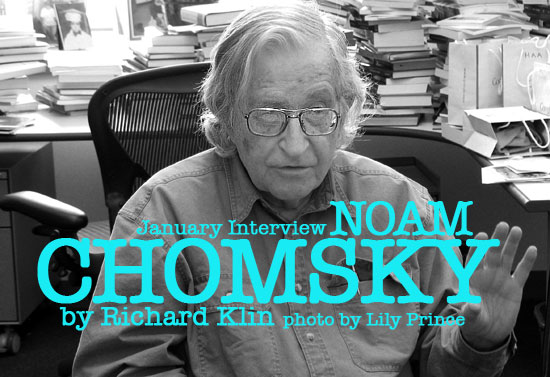
Writer and linguist Noam Chomsky (Making the Future, How the World Works), was born in Philadelphia on this day in 1928. From Writer’s Almanac:
He said, “We shouldn’t be looking for heroes, we should be looking for good ideas.”
January Magazine interviewed Chomsky in 2008. That interview is here.

Labels: ,

.