Wednesday, January 05, 2011

Crime Fiction: Innocent Monster by Reed Farrel Coleman

Retired New York cop, sometime private eye and reluctant wine merchant Moe Prager returns in author Reed Farrel Coleman’s latest novel, Innocent Monster (Tyrus Books). It’s now 2006, six years since Moe’s ex-wife, Katy, was murdered (in Empty Ever After, 2008). He is divorced again and doesn’t even know where to find his lapsed P.I. license. That doesn’t stop daughter Sarah, though, from approaching him to help out a childhood friend in need.

Candy Bluntstone is the mother of Sashi Bluntstone, the art world’s latest little darling. Sashi is not even 12 years old yet, but already she produces paintings that are favorably compared to those of Jackson Pollack. Or she did, anyway. Sashi has disappeared, and the police are stumped as to her whereabouts. Moe agrees to help Sarah’s friend Candy find her child, if only to get his own daughter back into his life.

Aiding Prager are NYPD Detective Jordan McKenna, the frustrated cop assigned to this missing-persons case, and Jimmy Palumbo, a former NFL rising star reduced to working museum security. Between the three of them, they discover there is no end to the number of sick people in the art community who think that dying to increase the value of one’s work is perfectly reasonable. More than a couple of collectors, as well as one artist with a bad heroin habit, make no secret of the fact that Sashi’s death would be quite a lucrative turn of events for them.

It could also prove advantageous to Candy Bluntstone and her husband, Max: they’re broke. But even Max, who’s normally looked at as a parasite, is having a hard time accepting what’s happened. He is mourning not only the loss of a daughter, but the artistic career he himself could have enjoyed, had things turned out differently. Meanwhile, this case offers up the bizarre and enigmatic John Tierney. A tortured schizophrenic who has an almost mystical love/hate obsession with Sashi, Tierney lives in a cesspool of a house adorned with peculiar suffering Christ heads, their eyes blacked out. Tierney eventually becomes the prime suspect in the girl’s disappearance. Still, Moe finds himself feeling sorry for Tierney, even if he’s guilty of doing away with Sashi. Sometimes a killer is just too pathetic to hate.

Of course, this being a Moe Prager novel (the sixth, in fact), we know that the answer our investigating hero initially arrives at is not the right one. In the past, that pattern has had tragic consequences, and the same proves true in Innocent Monster. However, as in Empty Ever After, the pages of this new book offer signs of renewal for our wayward ex-policeman. In Empty, Moe found solace in the arms of his Puerto Rican P.I. partner, Carmella Melendez. That short relationship and business partnership has ended, and Moe mourns its loss; but Carmella’s influence can be felt throughout Innocent Monster. He seems to be not only a better detective, but a better person because of the brief time he spent with her. And now ...?

Well, in this story Moe Prager manages to heal a few of his oldest wounds, but fortunately for us, author Coleman leaves plenty still open for his man to work on over the years to come. ◊

Jim Winter is a writer, reviewer and occasional comedian in Cincinnati, Ohio, where he works in tech support. He’s a regular contributor to Crimespree and an occasional contributor to The Rap Sheet.

Labels: , ,

Monday, October 11, 2010

Crime Fiction: The Body and the Blood
by Michael Lister

Florida writer Michael Lister returns in his new novel to the life of troubled prison chaplain John Jordan. When we encounter Jordan in The Body and the Blood (Five Star), he has been clean and sober for some time and is even reconciling with his estranged wife, Susan. That’s a good thing, since Susan’s father, Tom Daniels, is a senior official at the Potter Correctional Institution, where Jordan works.

This story begins with the sister of inmate and artist Justin Menge paying him a visit for the first time in four years. Menge was accused of molesting the grandchildren of a powerful sheriff, Mike Hawkins, in neighboring Pine County. But Menge’s sister now believes he’s innocent, and she may have the evidence to prove it. Furthermore, Chaplain Jordan learns that his erstwhile father-in-law is more than happy to help her. It seems Menge has agreed to testify against the man who raped Daniels’ wife, Susan’s mother.

What brings Jordan and Daniels -- previously adversaries in this series -- together is a flyer announcing that a murder will take place during a Mass in Potter’s Protective Management wing. PM, as Protective Management is known, is where inmates are put when they don’t want to play the gang-like games of the general population in a maximum-security prison. Menge, being a convicted molester, is among the PM residents. Another is Juan Martinez, who seems to have gotten away with savaging Mrs. Daniels after a bank robbery gone wrong. Unfortunately, the authorities haven’t been able to prove Martinez’s guilt, because Daniels’ wife -- horrified and sickened by the attack -- destroyed all of the evidence in order to cleanse herself.

Not long after Jordan finds the threatening flyer, Justin Menge is slain. This despite the fact that Jordan, Daniels, two guards and several inmates were all able to see down Menge’s corridor, and witnessed nothing of the violence.

There are plenty of suspects in the murder. Martinez is one, as the dead man had threatened to testify against him. But then there’s Menge’s lover, Chris Sobel, himself a killer, who liked the idea of leaving prison with an artist such as Menge to start over. His proximity to Menge at the time of the murder makes a lover’s spat seem likely. Outside the prison, members of the Hawkins family would have liked nothing better than to see Menge pay dearly for mistreating their young Pine County relatives. And Sheriff Hawkins’ son is doing time in the penitentiary -- a son who is a bit too racist and homophobic even by Pine County standards. (Sort of like Huck Finn’s dad was too much of a bigot even for the Antebellum South. Scary, eh?)

The PM guards wouldn’t give even mall cops any reason to worry about their jobs. So it falls to Jordan and Daniels to investigate this crime, at the same time as Jordan attempts to reunite with Susan. Susan helps things along by announcing she’s pregnant. What hinders their reconciliation, though, is her insistence that Jordan leave Potter County for Atlanta, Georgia, where she runs a successful public relations firm. Coloring both the investigation and their marriage is the severe denial and trauma suffered by Susan’s mother.

In Chaplain Jordan, Lister paints a vivid portrait of a man who has conquered his addiction, but still has to face the causes of it. The protagonist’s temper occasionally flairs, and at one point, he slugs an inmate. It the same raw nerves that once drove Jordan to drink that now threaten to undo all the progress he’s made.

Jordan, by the way, isn’t your conventional clergyman. Not only does he refer to God as “She,” even in conversations with the prison’s part-time Catholic priest, but his father is the Potter County sheriff, and Jordan himself is a former deputy. So his investigation of Menge’s death isn’t the work of an amateur sleuth blundering haplessly into a crime. Daniels wants his son-in-law along ostensibly because Jordan is still, at heart, a cop, yet the inmates have come to trust him.

Lister puts a lot of coincidences into The Body and the Blood that could have derailed it in the hands of a lesser author. Fortunately, Lister handles them well. The story is not as edgy as his most recent Tyrus Books offering, Thunder Beach (2010). Instead, it’s comfortable, like an entry in a series that’s been around awhile and is more interested in keeping its fans than grabbing new ones. Still, Lister is one of the better writers working today. He doesn’t skimp on story development or the consequences of actions. Regular characters change and fall apart. And where this tale is at its best is in Jordan’s interactions with prison inmates. Some profess a disappointment when the chaplain tells them he’s not superior to them, that he struggles to be a better person every day in just the same way they do. What really disappoints them, though, and what the author portrays best, is how Jordan fails as often as he succeeds.

Fortunately for us, in this book, Lister succeeds. ◊

Jim Winter is a writer, reviewer and occasional comedian in Cincinnati, Ohio, where he does tech support for an insurance company. He’s a regular contributor to Crimespree and an occasional contributor to both The Rap Sheet and the comedy podcast The Awful Show.

Labels: , ,

Saturday, May 01, 2010

Crime Fiction: Thunder Beach by Michael Lister

Michael Lister continues his dark explorations of northern Florida’s underbelly in Thunder Beach (Tyrus Books), the standalone tale of a former stepfather who still feels a sense of duty toward his late wife’s children.

Journalist Merrick McKnight is spiraling downward. Fast. He’s having an unconsummated affair with a married stripper named Regan. He has lost his job at a daily newspaper in Panama City, Florida. And much of this slide in his life has taken place since his wife and their young son, Ty, died in a car accident. His marriage was an unhappy one, kept alive only because his wife’s two children, Casey and Kevin, loved McKnight. But now all of that has changed.

McKnight hasn’t seen his stepdaughter, Casey, for years. But while in Panama City, he happens to spot her in a photo on the cover of Miss Thunder Beach magazine, a publication affiliated with the town’s annual spring biker rally. So he starts looking for her, only to encounter some very bad men who threaten him and then smash up his shiny new Dodge Challenger.

With McKnight’s concern for Casey rapidly rising, the girl suddenly turns up, tells him that she’s fine, and asks that he leave her alone. She’ll call him if she needs him. Honestly. It isn’t long, though, before Casey does need his help--and more. A local sheriff, John Milton, informs McKnight that someone has filed a missing-person report on Casey (or Amber, as she’s now calling herself).

What follows is a convoluted trip through the world of strip clubs, prostitution, and white slavery in Panama City. Most of the story involves McKnight, the police, and even stripper girlfriend Regan trying to figure out what role, if any, an abusive man named Victor Dyson has played in Casey’s disappearance.

Lister doesn’t let anyone off easy here. Even when the police believe they’ve found Casey’s body, things only get more complicated.

The author’s prose is spare, with the dialogue introduced by dashes instead of quotation marks, à la Charlie Huston. And his narrative is laced with a peculiar sadness that permeates McKnight’s life.
I’ve come in search of a woman.

It seems I’ve spent my entire life searching for something--something elusive, evanescent--something usually involving a woman. Ironically, the woman I’m here to see is not the woman I’ll spend the next few days frantically trying to find.
There are a couple of patches where Lister interrupts his own first-person narrative and gets preachy. In one section, it’s clear that McKnight--and by extension, Lister--is pretty passionate about the decline of the newspaper industry in recent years. However, the passage he devotes to that subject reads more like a dissertation extract or a blog rant than Lister’s usual Spartan poetry. Fortunately, you can count those sections in a peace sign. Lister spends the greater part of his time putting us into a sultry Florida frame of mind with the rumble of motorcycles in the background.

Probably the most skillful bit of scene-building in Thunder Beach has to do with the bikers swarming Panama City. They are ever-present, loud, rumbling, a benign interruption in the normal life of the city. Sometimes they even create obstacles for McKnight and his police allies without deliberately getting in the way. But only near the end of this tale do any bikers play a major part.

Instead, there is Victor Dyson, an oily malevolence whose true nature is unknown. He’s clearly at the center of something that threatens Casey, but it takes McKnight the entire novel to learn what sort of monster Dyson truly is. In a story about the shades of gray that make up noir, Dyson is a glaring reminder that some people are outright and deliberately evil.

Counterbalance that against Merrick McKnight. In our modern world, where too many parents abandon their offspring and too many step-parents look at their spouse’s children as burdens to endure, McKnight steps up to the plate and does more than Casey and Kevin’s real father ever did before their mother died. For that alone, he’s a hero. But his devotion to Casey and her younger brother goes still further: McKnight will risk his own life and freedom to save them.

Novelist and screenwriter Michael Lister, already known for his series about Florida prison chaplain John Jordan, has written in Thunder Beach a poignant and lyrical noir story that’s as much about redemption as it is about shattered lives.

Labels: , ,

Thursday, April 22, 2010

Crime Fiction: The Deputy by Victor Gischler

After his takes on the apocalypse (Go-Go Girls of the Apocalypse, 2008) and medieval alchemy (Vampire a Go-Go, 2009), Victor Gischler returns to crime fiction with his latest novel, The Deputy (Tyrus Books). Toby Sawyer is an ex-musician who returned home to Coyote Crossing, Oklahoma, when his mother died, and ended up staying. The town’s sheriff gave him a job as a part-time deputy, even though he’s hardly a by-the-book type. After local thug Luke Jordan is shot, Toby is left to guard the corpse until the coroner arrives. Bored, Toby walks a couple of blocks to his girlfriend Molly’s place for a quickie, which she happily provides. But by the time Toby gets back to the scene of the crime, the corpse has gone missing. He tells another deputy, who sends him home.

To his wife and son. Toby’s wife, Doris, a waitress, doesn’t take the news of Luke Jordan’s death very well. In fact, she decides that they all need to move to Houston. Now. Toby is not ready to deal with this, and so heads back into town. By daybreak, he will have destroyed not only his car, but a semi-tractor and part of a motel as well. He will also have done battle with immigrant smugglers. His wife will have left him, and he will have killed several men. In other words, losing that corpse is only the start of a very long and life-changing night.

The Deputy is laced with Gischler’s usual humor. Toby Sawyer is the sort of lovable loser this author has put at the center of most of his novels, Gun Monkeys (2001) being the only exception. Coyote Crossing is the brand of small town that often features in Stephen King novels--a great place to be from, but way out on the edge of nowhere. Gischler’s motif, however, is the classic Western, only set in the 21st century. One can imagine horses and stagecoaches here in place of muscle cars and pickups. Gischler even cuts the town’s phone lines, sending everyone plunging back into the 19th century.

Gischler does a fine job of making Toby’s life more and more miserable as the long night of this tale winds down. His protagonist will not only likely lose his job, but possibly also his life, before the sun rises again. He spends most of the night wondering what has happened to the sheriff, even finding blood at that man’s house.

If you’ve read Gischler’s work before, you know somewhat how this story will end. You also know that The Deputy is going to be a helluva ride.

Labels: , ,

Thursday, March 04, 2010

Crime Fiction: The Cold Room by J.T. Ellison

J.T. Ellison’s latest Nashville-based novel, The Cold Room (Mira), finds her series homicide detective, Taylor Jackson, chasing an unusual serial killer. He starves his victims to death, violates their bodies and then poses them in elaborate re-creations of famous paintings. What bothers Jackson and her FBI profiler boyfriend, John Baldwin, is the scope of these slayings. It appears he has struck also in London and in Florence, Italy.

Ellison doesn’t hide this murderer from her readers, nor does she obscure the existence of a second serial killer, this one in Italy, called Il Macellaio (“The Butcher”). Our Nashville slayer is a graphic artist named Gavin. Nice guy. Drives a Prius. Admires the hell out of Il Macellaio. Also admires a famous photographer known simply as Tomasso. Gavin imitates the latter in his art work, and the former in his style of killing. So similar is his technique to that of his Italian counterpart, that Gavin’s crimes attract a British profiler to Nashville, one James “Memphis” Highsmythe. Memphis would be welcome on the investigation, if he didn’t have the almost pathological hots for Detective Jackson.

The Cold Room combines The Silence of the Lambs with The Wire. Jackson is a strong, capable investigator who, as we see in several subplots, is having to cope with institutional dysfunction. She’s been demoted from head of the Murder Squad and placed under Lieutenant Elm, a former New Orleans cop obsessed with administrative detail and with a hair-trigger temper. In the meantime, she and her former teammates are dealing with the aftermath of events in Ellison’s last novel, Judas Kiss (2009). She’s been reduced in rank from lieutenant and saddled with a new detective, Renn McKenzie, whom she suspects isn’t worthy of her trust.

Jackson is hard-nosed and a workaholic. Walking into a room, she is immediately in charge, her fellow officers snapping to, not really accepting her lowered status. I like her new partner, too. At first, McKenzie seems to be a stereotypically green upstart, but Ellison fleshes him out as he is exposed to two bizarre murders and a third attempt in less than five days. McKenzie evolves nicely as a result, and will probably make a welcome addition to this series.

The Cold Room character I found grating, however, was Memphis Highsmythe. He could have been an amazingly complex figure, someone dealing with his own grief. Instead, the New Scotland Yard detective came off as a self-centered jerk, unfortunately gifted with investigative talents rivaling those of Jackson and Baldwin. He was supposed to provide a complication for that couple, but in almost every scene, I wondered when Jackson was going to whip out the mace, the taser or the Louisville Slugger. Highsmythe is the kind of guy women find it easy to strike out at in return for their advances.

But if Highsmythe is the low point, then this novel’s mystery, and Taylor Jackson herself, represent its high points. The case of Gavin and his online friend, “Morte,” grows increasingly complex as this tale moves along. Jackson handles the investigation smoothly, sweating more over her relationship with Baldwin than her woes in Homicide. If anything, pursuing her quarry revitalizes the detective.

Author Ellison has done a fine job chasing serial killers. Now, if she’d just learn to throw a drink or two at annoying British detectives...

Labels: , ,

Wednesday, January 27, 2010

Crime Fiction: The Bricklayer by Noah Boyd

Lee Child spawned a new type of protag when he introduced former military cop Jack Reacher. Well, new but old. With roots in Clint Eastwood’s Man with No Name, Reacher is the contemporary drifter hero, a guy not really tied to law enforcement, but out to do justice nonetheless. Of course, that justice has some strange definitions. Lately, we’ve seen Matt Hilton with his ex-British Army “problem solver,” Joe Hunter, and even Child’s younger brother, Andrew Grant, with his renegade MI6 op, David Trevellyan, emerge as the modern cowboy, the one writing his own rules because the system’s rules just don’t work.

Which brings us to newcomer Noah Boyd’s The Bricklayer (Morrow). In it, a clever killer has set up a plot to frame the FBI for slayings he commits in the name of a bogus terrorist organization, the “Rubaco Pentad.” A reporter who blew the lid off corruption in the Bureau’s Los Angeles office is murdered. Then, when the FBI attempts to pay the Pentad extortion money, the agent sent on that errand is also done in. Another one disappears, apparently part of this growing conspiracy to disgrace the Bureau.

What’s a beleaguered FBI director to do?

In Boyd’s tale, he rehires an agent who had been fired for his inability to respect authority. Steve Vail was canned not for political reasons, but because he preferred to see a cop-killer go to prison rather than take down a superior so obviously guilty of manufacturing evidence. Vail has since found employment as a Chicago bricklayer, a job that requires little supervision or human interaction. However, he is lured back to the Bureau by an attractive former colleague, now the FBI’s deputy assistant director, Kate Bannon.

Vail soon begins to justify his rehiring. But he isn’t satisfied with his success. He hates loose ends. Rather than congratulate himself on solving a case when everything falls into place, he pulls on the investigative strands that remain unconnected. His wariness keeps him from being killed when the Pentad demands a nearly impossible money drop in an abandoned L.A. subway tunnel. Thinking three steps ahead of his foes, Vail realizes they’ve booby-trapped the drop.

In the wake of his survival, Vail looks more closely at who might stand behind this escalating mayhem and apparent revenge. There’s a lot of pesky evidence leading to the involvement of that missing FBI agent. Yes, the agent is now dead, an apparent suicide. Vail, though, doesn’t like that solution.

“Too neat,” he says.

Author Boyd flirts with giving Vail superhuman intellect, but manages to balance his aptitude by simply making him shy of accolades. While the rest of the Bureau’s L.A. field office is celebrating what they think is the end of the Pentad case, Vail is still asking himself the meaning of one unaccounted-for piece of the puzzle.

Thanks to Bannon’s presence here, Vail is not just another lone wolf outsmarting a stupid bureaucracy. Even a rival admits to Vail that the FBI is a bit rigid in its thinking. With Bannon, this is a double-edged sword. Vail’s loose-cannon approach to the case is something she admires, but it also underscores trust issues that infuriate her. At one point, Vail is even fired and wanted by the cops for theft.

And let’s be honest, it’s not like Vail is invincible. Escaping death by the slimmest of margins quite often hurts like a mother, and both Vail and Bannon come out of the experience physically scarred.

There are certainly weaknesses in The Bricklayer. The presence of Assistant U.S. Attorney Tie Delson is somewhat annoying, as she throws herself at Vail, kind of like the office coworker who can’t hide her crush on the new guy. Her ardor for Vail is eventually explained, but it strains the story in places.

Still, the person behind the Pentad is one of the more clever villains I’ve seen in a long time. He’s not really all that brilliant, but he is just smart enough to anticipate what the FBI will do next, and foil its efforts. Eventually, even Vail makes mistakes. Indeed, there’s a place in this tale where he should have been killed.

Boyd’s writing is solidly paced with few, if any, inconsistencies. Probably his greatest strength is in conveying through his writing the action and tension of a Jason Bourne movie or Casino Royale. Taut, rapid-fire and relentless.

READ MORE:Ex-FBI Agent Paul Lindsay Lays the Bricks for a Successful Writing Career,” by Jim Sullivan (Boston Herald).

Labels: , ,

Tuesday, December 01, 2009

Crime Fiction: The Good Son by
Russel D. McLean

In Russell D. McLean’s debut novel, The Good Son (Minotaur), J. McNee is a broken-down ex-cop in Dundee, Scotland, still reeling from the death of his girlfriend Elaine. Into his life walks James Robertson, wanting closure to the recent suicide of his estranged brother, David. McNee takes the case, only to run afoul of London gangster-turned-celebrity Gordon Egg. Egg sends a couple of psychotic hard cases out to clean up the mess left behind by David Robertson. In the process, David’s lover Katrina, aka Mrs. Egg, is murdered. Private eye McNee decides to back off the investigation and focus on insurance work. But the hard cases have other ideas. And McNee, as a result of a beating, learns that his client is not telling the whole truth about the night his brother hanged himself from a tree.

The motif of a traumatized P.I. is a natural one to tell McNee’s story. Becoming a gumshoe in Scotland doesn’t invite the same respect that it might in England or America. In Scotland, especially in smaller cities such as Dundee, an investigator ranks slightly above dope pusher and below repo man. McNee doesn’t care. He spends most of his days working through insurance cases and looking for one more reason not to grieve. For whatever reason, he finds a purpose in learning what led to David Robertson’s death. It nearly kills him and his assistant, Billy.

Not as violent or coarse as fellow authors Ken Bruen and Ray Banks, McLean nonetheless skillfully mines the same ground for a bleak and desperate literary landscape. It’s easier to empathize with McNee, since his wounds are still relatively fresh. Unlike Bruen’s Jack Taylor, who admits he’s insane, or Banks’ Callum Innes, who simply stopped caring about himself a long time ago, McNee is well aware that he’s thrown up walls around himself, but seems utterly helpless in escaping them.

There’s a longer-term story McLean is creating here, and we’ve certainly not seen the last of J. McNee. Whatever comes next promises to be ever bit as hopeless and violent as The Good Son. And that’s a good thing. McLean has scored in his first novel.

Labels: , ,

Thursday, November 26, 2009

Crime Fiction: Peepshow by Leigh Redhead

Simone Kirsch gets naked for a living. As we learn in Leigh Redhead’s 2004 thriller, Peepshow (recently re-released by The Outfit), she works in Melbourne’s sex industry as a peepshow performer. Wanting something better, and knowing that strippers often have short careers, she’s earned her license as an “inquiry agent,” Australia’s term for private investigator.

Her first case?

Strip club owner Frank Parisi has been stabbed and dumped in the ocean. Sal Parisi wants someone to pay for his brother’s death. He picks Simone’s pal Chloe, since Chloe had a beef with Frank. Simone manages to talk Sal out of killing her best friend, but of course the trade-off is that now she has to find the real killer. Just to be sure he’ll get what he wants, Sal kidnaps Chloe as collateral. Simone begins her investigation by taking a job as a stripper at Frank’s club, the Red Room. Things soon turn ugly. She runs afoul of Dick Farquhar, a corrupt cop. She also manages to pick up a boyfriend with anger issues. From there, Simone engages in a cat-and-mouse game with Sal, Farquhar and possibly an unknown suspect. And she immerses herself in the stripper role, even indulging a coke habit she’d already worked so hard to kick.

Author Redhead draws on her own personal history to paint a vivid portrait of Melbourne’s seedier side. The city that tourists visit and in which ordinary office employees live isn’t so different from the Melbourne that sex workers inhabit. And making this clear is perhaps Redhead’s biggest accomplishment. The strippers and peepshow performers work in a business, and the city they live in isn’t some sort of alien landscape. The men in Peepshow tend to be a bit aggressive, often after only one thing. But then again, most sex workers, legal or otherwise, see only a single type of male in the course of their work -- denizens of a seedy underworld that Redhead shows us is only a few steps away from our own.

Labels: , ,

Saturday, August 01, 2009

Fiction: Better by John O’Brien

Better is what it sounds like inside the head of a man drinking himself to death. Overconsumption is a common theme in the work of John O’Brien (who also gave us Leaving Las Vegas) and, sadly, in his foreshortened life as well. In Better (Akashic Books), O’Brien’s final novel, he tells part of his tale within the surreal confines of a mansion owned by a man known only as “Double Felix.” William is a slacker who drifted into Felix’s orbit, and wound up staying. His only duties are to drink Morning Vodka and share an evening libation with Felix. The rest of his day consists of imbibing gin, watching Love Boat reruns and bedding the various female guests of the mansion, including partygoer Maggie and one-time call-girl Zipper. When he’s not doing those things, he sleeps a booze-induced sleep on the back deck.

But then another girl named Lisa arrives and upsets Felix’s perfect little world of hedonism. Felix is obsessed with her, and her presence alarms the other women (and one other man). She even drives Zipper to try and get William to quit drinking.

Better is a bizarre story written in a jarring style. O’Brien seems to be invoking F. Scott Fitzgerald, another writer who battled demon rum and lost. However, this novel, with its aimless pursuit of pleasure, also suggests influences from another literary heavyweight, Jack Kerouac, in its abandonment of the real world in exchange for meaningless sex and endless booze. The cracks are showing at the beginning, however, when Felix declares that things are not entirely well with his source of income. Lisa seems to be at the center of it all, her connection to Felix eroding his control over the house. She even causes a rift between Felix and William. By the end of the story, William is pondering running off with Zipper, the whore who ironically loves him, and drinking himself to death.

I don’t think Better is an appropriate title for O’Brien’s last novel. The destruction of Double Felix’s private pleasure dome over the course of a day invokes yet one more literary masterpiece.

Paradise Lost.

READ MORE:John O’Brien’s Better,” by Devin Tanchum
(Book Soup Blog).

Labels: , ,

Monday, July 13, 2009

Crime Fiction: Bad Things Happen
by Harry Dolan

In Harry Dolan’s Bad Things Happen (Putnam), a man who calls himself David Loogan settles into Ann Arbor, Michigan, to live a quiet life. Bored, he writes a short story that he tosses over the transom of a local crime-fiction magazine called Gray Stories, a clever publication sure to make the denizens of Rara-Avis giddy with visions of fresh noir. Rather than being published, though, he is hired by Tom Kristoll to edit Gray Stories. Before long, Loogan becomes a favorite drinking companion for Tom and a lover for Tom’s wife, Laura. So it’s no surprise who Tom calls when there’s a dead body in his den. He calls the man who calls himself David Loogan. Loogan helps bury the corpse and then ditch the car used to transport it.

That, supposedly, is that.

Until Tom suddenly ends up face-first on the pavement in front of the offices of Gray Stories. Then an intern smitten with Laura apparently shoots himself. Police believe the intern committed suicide in a fit of remorse for having slain Tom Kristoll. Only whatever triggered this series of deaths is far from finished. While Loogan is enigmatic, admittedly behaving like a character one might read about in Gray Stories, he is not considered a suspect, having always been somewhere among people--witnesses--when the killings occurred. But as local police Detective Elizabeth Waishkey digs into the expanding homicide case, Loogan’s past comes back to complicate matters.

Author Dolan starts Bad Things Happen with the feel of an old Alfred Hitchcock movie, maybe Strangers on a Train. Loogan is no Jimmy Stewart or Cary Grant, however--he’s far too brooding. Still, one can certainly picture Ray Milland or James Mason playing the part of Tom Kristoll, oozing charm as he lures Loogan into a bizarre web of intrigue. The one thing that strains credibility is Gray Stories itself, a profitable print version of Plots With Guns. Oh, were it a real magazine ... but I digress.

Throughout the yarn, Loogan lightens the mood by juggling for various people. It’s rather appropriate, since Dolan himself is juggling at least four subplots in these pages, as well as a cast of characters likely to inhabit the bar at any writers’ convention. His complex tale has to shift quickly from one thread to the next in the book’s short length, thus helping to ratchet up the suspense. It doesn’t hurt, either, that almost everyone is lying in this story, even when they’re telling the truth.

Bad Things Happen is a clever debut novel mixing wishful thinking with a morally ambiguous cast. Just the kind of tale you would expect to read in Gray Stories.

Labels: , ,

Monday, June 08, 2009

Review: Liars Anonymous by Louise Ure

Today in January Magazine’s crime fiction section, contributing editor Jim Winter reviews Liars Anonymous by Louise Ure. Says Winter:
“I got away with murder once, but it looks like that’s not going to happen again.”

That is how Jessie Dancing begins the tale of her former life coming back to haunt her in Liars Anonymous. Jessie works for HandsOn, an OnStar-type service for motorists in distress. The trouble begins when real-estate developer Darren Markson is involved in a collision out in the Arizona desert, and Jessie fields his call. At first, it seems like nothing, a late-night accident; but then Jessie hears sounds of fighting over the phone. By morning, Markson is reported missing, and Jessie is summoned from Phoenix to go to Tucson, where she’s to talk with police and meet Markson’s wife, Emily.

Tucson is the worst place for Jessie to go. It’s been three years since she stood trial there for the murder of abusive Walter Racine, only to be acquitted of the crime. She has since changed her name, her look and her life. But her mother has shunned her from their family’s life. Only Detective Deke Treadwell of the Tucson PD and Jessie’s father believe she’s innocent.
The full review is here.

Labels: , ,

Friday, May 29, 2009

Crime Fiction: Back to the Coast by Saskia Noort

Life is rough for Maria Vos, a Dutch soul singer from Amsterdam, in Saskia Noort’s Back to the Coast (Bitter Lemon Press). Realizing that her boyfriend Geert is exactly the kind of irresponsible man she doesn’t want fathering her children, she aborts their second child together. The ensuing argument leads them to break up. A rough patch in this young woman’s life? That’s all it seems, until someone begins sending Maria threatening letters in the mail, condemning her decision to have an abortion.

Geert is the obvious suspect, at least as far as everybody but Maria is concerned. She doesn’t believe he would ever threaten her like that, not given what it would mean to their son Wolf, or to Merel, the daughter Maria already had when they became a couple. Maria thinks the person responsible might instead be Merel’s father, Steve, a vain and irresponsible man who has suddenly reappeared in their lives, apparently tired of residing abroad in America. The threats escalate, with Maria receiving a dead rat after a band gig. So Maria flees to The Netherlands’ coast and her childhood home there, now kept by her sister, Ans. Instead of finding it a safe haven, however, Maria finds herself driven literally insane the longer she stays on the coast, to the point where she no longer trusts her sister.

Back to the Coast, the second Bitter Lemon Press book by Dutch author and journalist Noort (following 2007’s The Dinner Club), is noir in the classic sense, harking back to the famous 1944 film Gaslight. But whereas that movie’s audience knows that Charles Boyer is “gaslighting” Ingrid Bergman, we have no idea who is trying to destroy Maria and take her children away from her. The stalker, who follows Maria to the seashore, is clearly filled with a rage for which the police cannot seem to find justification. If anything, the cops think Maria is slowly losing it. Why shouldn’t she? Her mother was certified psychotic and took her own life. There is no shortage of suspects here, either. Geert is everyone’s favorite, of course, though Maria dismisses his culpability out of hand. She favors Merel’s father, but once at the coast, she also learns that Ans’ husband, Martin, has disappeared. Or has he?

Noort writes her story in first-person from Maria’s point of view, allowing her to immerse the reader in her protagonist’s growing confusion and fear. It also allows Noort to tell snatches of the story through Wolf and Merel’s eyes, mostly through their reactions to Maria’s increasing blackouts. It’s a tricky line to walk for a writer. Noort carefully leaves enough semblance of a story for readers to follow, while the world around Maria makes less and less sense. It’s almost like reading James M. Cain through singer Syd Barrett’s eyes.

Back to the Coast is two parts noir, one part horror fiction, and very well done indeed.

Labels: , ,

Monday, March 09, 2009

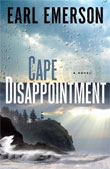
Review: Cape Disappointment by Earl Emerson

Today in January Magazine’s crime fiction section, contributing editor Jim Winter reviews Cape Disappointment by Earl Emerson. Says Winter:
If reading and reviewing books over the past couple of months has shown me anything, it’s that we’re ready for change. Three out of the last four books I have reviewed had an undercurrent of anger toward the American government as run by George W. Bush. Thomas Lakeman’s Broken Wing barely disguises the author’s rage at military contractors such as Blackwater. Olen Steinhauer’s The Tourist does no favors for the CIA. And then there’s Earl Emerson’s first private eye Thomas Black novel in 10 years, Cape Disappointment.

Emerson starts this novel off with a bang. Literally. Black, a Seattle sleuth (last seen in 1998’s Catfish Café), recounts his too-close-for-comfort experience with a bomb explosion inside a school gymnasium, where a political candidate had been speaking. Since he was smacked against the wall and impaled, Black’s description is naturally surreal, disjointed and horrifyingly graphic. The story lurches and halts between the recent past, where Black recalls talking to his wife on the phone as he watched her plane suddenly crash, and the present, while he’s trying to recover in a hospital bed. Black’s tale becomes coherent when he’s able to focus on the beginning of his latest adventure.
The full review is here.

Labels: , ,

Monday, March 02, 2009

Review: The Tourist by Olen Steinhauer

Today in January Magazine’s crime fiction section, contributing editor Jim Winter reviews The Tourist by Olen Steinhauer. Says Winter:
Olen Steinhauer takes on the reality of James Bond’s world in his latest novel, The Tourist. His story doesn’t involve tuxedoes, fancy gadgets or gorgeous femmes fatales. What it does involve is lying.

A lot of lying.

This tale opens on September 10, 2001, and a CIA operative using the name “Charles Alexander” has just botched a mission in The Netherlands. The pill-popping field agent did manage to stop an assassin known as “The Tiger” from killing a Dutch politician friendly to U.S. interests. However, he failed to take the bullet in his quest to end his “tourism,” the Central Intelligence Agency’s euphemism for working undercover in the field.
The full review is here.

Labels: , ,

Monday, February 16, 2009

Review: Skin and Bones by Tom Bale

Today in January Magazine’s crime fiction section, contributing editor Jim Winter reviews Skin and Bones by Tom Bale. Says Winter:
It starts off quietly enough. Julia Trent ventures to the tiny hamlet of Chilton, north of London, to clean out her recently deceased parents’ home. On a quiet January morning, Julia finds herself stalked by a man with a gun. He’s already murdered several people in the village. She runs, hoping to get away, and is saved by Philip Walker, the hamlet’s anti-development crusader. Walker’s been shot already, but he stares down the killer, a local man named Carl Forester, known for being a bit mental as it is. Walker threatens Forester and is shot again, this time fatally. Just when Julie thinks all is lost, a man in a motorcycle helmet arrives. She’s saved.
The full review is here.

Labels: , ,

Tuesday, February 10, 2009

Review: Good People by Marcus Sakey

Today in January Magazine’s crime fiction section, contributing editor Jim Winter reviews Good People by Marcus Sakey. Says Winter:
If you suddenly had half a million dollars, what would you do with it? In Marcus Sakey’s latest thriller, Good People, Tom and Anna Reed find out. After a fire alarm goes off in the ground-floor unit of their Chicago duplex, they discover their tenant dead in his bed from a drug overdose and a stash of cash in his kitchen. Perhaps they should have asked themselves where it came from before they claimed those riches as a windfall.

Their renter, who called himself Bill Samuelson, seems to have secreted more than $300,000 in flour sacks, cereal boxes and other receptacles. The Reeds don’t miss their tenant so much. Samuelson wasn’t the friendliest neighbor, but at least he paid his rent on time and minded his own business. And his demise looks like a blessing.

The full review is here.

Labels: , ,

Monday, October 27, 2008

Review: Angel’s Tip by Alafair Burke

Today in January Magazine’s crime fiction section, contributing editor Jim Winter reviews Angel’s Tip by Alafair Burke. Says Winter:
“In a city full of victims, it’s hard to choose just one.”

So goes the tag line to Alafair Burke’s second Detective Ellie Hatcher novel, Angel’s Tip. The story begins with wild Chelsea Hart from Indiana becoming Manhattan’s latest victim. She spends the first chapter dragging two friends from one party to the next on their last night of spring break.

The following morning, Hatcher finds Chelsea’s hacked-up body during a morning jog through East River Park. Hatcher is not even on duty, but she and her new partner, J.J. Rogan, catch the case. Their boss, Lieutenant Dan Eckels, would prefer to give it to someone other than Hatcher, but he nonetheless puts the pair to work.
The full review is here.

Labels: , ,

Monday, September 08, 2008

Review: The Turnaround by George Pelecanos

Today in January Magazine’s crime fiction section, contributing editor Jim Winter reviews The Turnaround by George Pelecanos. Says Winter:
It’s 1972, and Alex Pappas doesn’t want any trouble. He just wants to go to college and become a writer. He’s not even interested in taking over his father’s coffee shop, much as his father wants him to do. Hoping to stay clear of trouble, as well, is James Monroe, who wants to become a mechanic like his own father. But when Alex and two friends make a beer-fueled run into Washington, D.C.’s Heathrow Heights, an isolated black neighborhood, their worlds are irrevocably ruined. A shouted racial epithet turns into a fight that leaves one boy dead, Alex maimed and James headed for prison.

Dead is Billy Cachoris, who drove the car into Heathrow Heights with Alex and another boy, Peter Whitten. One of those boys throws a cherry pie at someone and yells “Nigger!” That sets off Heathrow Heights kid Raymond Monroe, James’ younger brother, and sparks a fight between the boys in Cachoris’ car and the neighborhood boys. Egging on the Monroe brothers is a thug-in-training named Charles Barker. The fight, which costs Billy Cachoris his life, sends both Peter Whitten and an injured Alex Pappas running.
The full review is here.

Labels: , ,

.