Monday, August 15, 2011

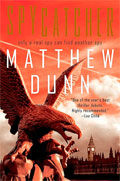
Crime Fiction: Spycatcher/Spartan by Matthew Dunn

Today in January Magazine’s crime fiction section, contributing editor Ali Karim reviews the book known as Spycatcher in the U.S. and Spartan in the U.K. Says Karim:
There can be no doubt that the man who composed this novel is someone who has survived residency in the realm of modern espionage. Novels by people only claiming an inside track just try too hard. Dunn gives the reader the sense of being on the Titanic and seeing the fatal iceberg emerging from the ocean mist ahead. Only the tip of that behemoth is visible, but you know that you’re sailing inexorably toward a beast, and that the real horrors remain hidden. Dunn’s story focuses on to the uncertainty of fear, and the matter-of-fact brutality that people in the intelligence game witness. Through the eyes of his characters we follow that brutal path. What we see and feel is not pleasant, but at times the recoil of catharsis in such a random world seems comforting.
The full review is here.

Labels: ,

Wednesday, November 03, 2010

007 to Go Digital

These days, the discussions are not so much is if electronic books are going to take root and take hold. On a book-by-book basis, it’s really just a matter of when. Case in point, even good old 007, who some might expect to be moldering away somewhere by now, is getting a digital makeover:
Amid all the talk about e-book publishing taking over from paper, and with some authors having turned evangelical on this topic, I was interested to see that Ian Fleming Publications has finally decided to publish the James Bond catalogue in electronic form, even bypassing the Penguin Group, the novels’ longtime English-language publisher.
Ali Karim has the whole story today on The Rap Sheet.

Labels: , ,

Sunday, May 09, 2010

Cover Version

Over at The Rap Sheet, we often see posts about copycat book covers, and the issues of judging a book by its jacket. The Sunday Observer takes a look at the importance of book covers and how they translate internationally:
What you are trying to get across on a cover is the essence of a book, quite an ambiguous thing," says Nathan Burton, a British designer who created the striking cover for Ali Smith's The Accidental, based on an image of a dead woman. "Designers in different countries read and interpret the fiction in different ways." It doesn't quite explain how Germany arrived at silhouetted dancers for House of Meetings, but "the germ of an idea can come from anywhere," says Burton. He points to the Swedish cover of The Accidental, on the surface a starkly different treatment – "but there's a photograph of a girl, bold sans serif type... You could argue that they are born out of a similar thought process."

There are colder business reasons for creating jackets that differ by territory, says Julian Humphries, head cover designer at Fourth Estate: "Different sales channels have different sensibilities." It can be hard to pinpoint what exactly these sensibilities are – "It's a cultural thing," he says, "as taste-driven as different countries eating different things for breakfast" – but broadly speaking, literary fiction is an easier sell in mainland Europe than in the UK or the US, so publishers there can be less overt in their attempts to grab the attention of customers. "In Europe you often see book covers with simple images and plain type, and that sells books for them," says Burton, whose colourful design for A Fraction of the Whole by Steve Toltz stands in stark contrast to the black-and-white German edition. "The UK book market is more competitive, all the covers in shops shouting: 'Buy me!' We have to put on a bit of extra spin."

The US, meanwhile, tends to signpost its literary fiction more than the UK, says Humphries. "With their version of Wolf Hall, for instance, they picked out the history bent of the novel much more. Theirs was a great cover, and won prizes everywhere."

Why don't publishers, then, replicate covers that have been a success abroad? "It does happen but it's quite rare," says Humphries. Megan Wilson, an art director at Knopf Doubleday in New York, says that American designers are sometimes asked to look at British jackets, "as an example of something that works or doesn't, but we are rarely asked to use them directly". Burton tries to avoid looking at alternative covers if he's working on a book that's already been published. "It can take you off on odd tangents. It's always best to work from fresh."
There’s more to The Observer’s story and it’s here.

Incidentally, The Sunday Times reports that the three biggest-selling paperbacks in the UK in April were Volumes I, II and III of Stieg Larsson’s bestselling Millennium Trilogy, which last week held the No. 1, 2 and 4 positions. (The Korean, U.S. and UK covers of the first book in that series are shown above right.)

Labels: ,

Thursday, April 22, 2010

Driven to Read

As a strong advocate of literacy and bibliotherapy, even I have to admit to having limits as this story from the BBC indicates:
A bus driver has been suspended after a passenger filmed him apparently reading while driving along a dual carriageway in Birmingham.

The passenger, who wishes to remain anonymous, filmed the National Express West Midlands driver steering with his elbows while holding a small book.

They said they took the footage after getting on the number 61 bus at Selly Oak at 2005 BST on Monday.

National Express West Midlands said “immediate action” was taken.

The footage has since been posted on video sharing website YouTube.
The story is here.


I wonder if he was reading this book as it has become ubiquitous in the UK?

Labels: ,

Monday, April 19, 2010

London Book Fair Opens Under the Volcano

The London Book Fair gets underway at Earl’s Court today. This is an event I enjoy attending annually to gauge the state of publishing which has been suffering from the twin-pronged approach of economic and technological challenges.

This year the Fair faces another problem: the ash falling over Europe from the Icelandic volcano that has cleared the skies of aircraft. Many people will be unable to attend the Fair due to the air-travel blackout, while others on mainland Europe are changing their air-travel arrangements to ferry, road and Eurostar Rail methods. The result might be a shortage of attendees from the United States and other overseas territories.

As the madness of the Fair arrives in London this week, The Observer’s Robert McCrum spends a day with legendary agent Andrew Wylie in New York:
Today he comes to greet me in the tranquil, overheated hallway of his 12th-floor office as the day closes and the evening light merges into the fluorescent glare of uptown off-Broadway. In person, Wylie is slight, courteous and soft-spoken -- as if with his dark suit and formal good manners he can live down his reputation as competitive, self-willed, transgressive and ruthless.

The contrast between his polite self-presentation and his erstwhile reputation as a hell-raiser and “a lizard” makes for an edgy formality. But it doesn’t take long for his sardonic bad-boy self to break through the mask. Wylie's minimalist office displays several promotional copies of the Nabokov backlist in various foreign editions. When I comment on the number of literary estates (Borges, Mishima, Waugh, Lampedusa and Updike, to name some of the most prominent) controlled by the Wylie Agency, he says, with a mirthless laugh: "People are dying like flies." It's at moments like this that you can see why, in the Anglo-American book world, he is known, simply as "the Jackal".

Once a more than slightly feral predator, however, Wylie has now become something far more menacing in the literary undergrowth. In a business environment where many of the principal publishers, booksellers and rival literary agents are reeling from the remorseless depredations of recession and digitisation (the IT revolution), he can make a good claim to be the most powerfully composed and uniquely global writers' representative on either side of the Atlantic, a king of the book publishing jungle.
McCrum’s piece is lengthy, interesting and here.

Labels: ,

Friday, December 18, 2009

The Best Unread Books of the Decade

As many in the media present their lists featuring books that defined the decade, I often ponder upon the books that missed my radar. January Magazine will be unveiling its best of 2009 lists shortly. While sending my crime and thriller choices to Rap Sheet editor, J. Kingston Pierce, I pondered on the games fate and luck play in life. Many highly successful writers have often indicated that much of their success can be laid down to “luck” or “fortune” and that it took many clicks on the wheel of fortune to get success. I know many worthy books remain on the shelf because fortune and fate didn’t play a hand. I enjoy books that give me challenge and I am always on the look out for something that can alter or reinforce my view of life.

It was rather interesting to read The Guardian’s decade’s best unread books:
While people are busy ranking the hit books of the last 10 years, many a publishing insider is quietly mourning a volume that unnaccountably never made the 'best of' or bestseller lists, but should have. Here publishers, agents and translators speak up for the ones that really shouldn't have got away.
I read this listing and selected the following to purchase this afternoon as they intrigue me and I am surprised I missed them:

From Christopher MacLehose, MacLehose Press publisher:
Journal by Hélène Berr, published in 2008, deserves to be read and studied in every school in the civilised world, read and reread for what it tells of the circumstances of the arrest of a young and brilliant Jewish girl in Paris and her eventual murder in Bergen-Belsen, days before that camp was liberated. The story of how the text of her journal came to light so many years later is remarkable enough. The journal, which is a love story too and an account of inescapable horror, is beautiful and beautifully translated by David Bellos, whose Afterword entitled France and the Jews is also essential reading.
From Isobel Akenhead, Hodder & Stoughton women’s fiction editor:
The one book I would say I felt almost physically heartbroken about not succeeding with in the last decade was The Girl Who Stopped Swimming by Joshilyn Jackson. She's the most phenomenally talented (and bestselling) American author, whose unique voice just sings off the page, and this brilliant novel tells the tale of a woman who has to search through her own past to uncover what really happened to a little girl who has just been found dead in her swimming pool. It's as pacy as a thriller, but so rich that you feel you're reading something much deeper. There were a number of reasons it wasn't the success we hoped for -- primarily I think that it trod the line between commercial and literary in a way that made the retailers struggle to understand it. But I'd urge anyone to read it -- I feel absolutely sure they wouldn't be disappointed.
Here’s The Guardian’s complete list of books that may have missed your radar.

Labels:

Friday, September 11, 2009

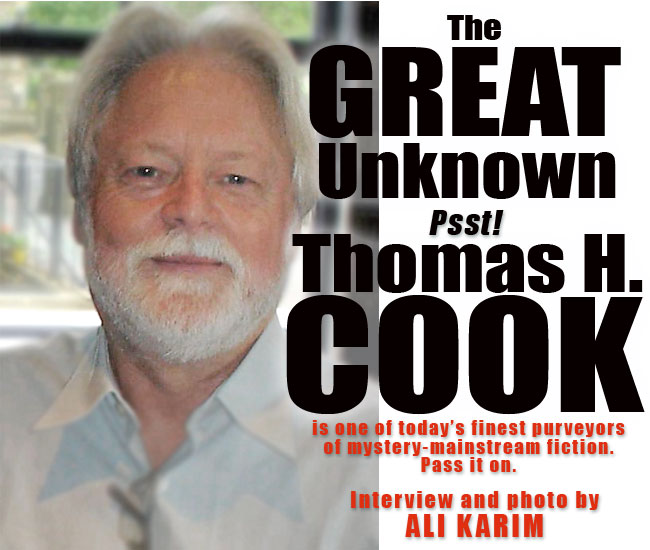
Interview: Thomas H. Cook

Today in January Magazine, contributing editor Ali Karim interviews Thomas H. Cook, author of The Fate of Katherine Carr and a writer who just might be the best known author you’ve never heard of.

“You like puzzling out the solutions to mysteries?” asks Karim. “Then tackle this one: why isn’t American Thomas H. Cook one of the world’s biggest-selling authors? He’s prolific, with more than two dozen crime and suspense novels to his credit, plus non-fiction books and anthologies he has edited. He won an Edgar Award for his 1996 novel, The Chatham School Affair, and 2005’s devastating Red Leaves was nominated for an Edgar, a Crime Writer’s Association Dagger Award, an Anthony Award, a Barry Award and Sweden’s Martin Beck Award.”

Read Karim’s interview with Cook here.

Labels: ,

Thursday, August 06, 2009

Lightning Strikes Twice

January Magazine has been following Linwood Barclay’s career for many years. Thus we know, as well as anyone can, that his success with No Time For Goodbye certainly is no flash in the pan. As reported by The Bookseller:
Thanks in part to a spot in W H Smith's "£2.99 if you buy the Times" promotion, Linwood Barclay's Too Close To Home (Orion) has soared to the top of the bestseller lists, in another strong week for the trade.Barclay's follow-up to the 2008 smash hit, No Time for Goodbye (Orion), sold 45,622 copies during the seven days to 1st August, in a week when book sales jumped 2.5% on the previous week to 4.6m copies sold—a 2009 high. £30.9m was spent at UK book retailers last week, according to Nielsen BookScan Total Consumer Market data, up 5.1% year on year.And in exactly the same scenario as last year, Jeffery Deaver's latest thriller has to settle for second position behind Barclay. The Broken Window (Hodder), his second Kathryn Dance thriller, sold 32,795 copies through the market last week. In the same week last year, the continuing popularity of Barclay's "Richard and Judy" Summer Read, No Time for Goodbye, ensured Deaver's Lincoln Rhyme thriller, The Sleeping Doll (Hodder), was kept off top spot.
The full piece is here.

Linwood’s latest novel, Fear the Worst, has just been released, and the Canadian author and journalist is embarking on a virtual book tour:
Join Linwood Barclay as he travels the blogosphere in August 2009 with Pump Up Your Book Promotion Public Relations on his first virtual book tour to discuss his new suspense novel, “Fear the Worst” (Bantam Books).

One evening your child doesn’t come home for dinner. And just like that the world you thought you knew becomes a strange and terrifying place.

Tim Blake thought he knew his teenage daughter as well as he could know anyone. But when Sydney vanishes into thin air, all she leaves behind are questions. At the hotel where she was supposedly working, no one has ever heard of her. Even her closest friends can’t tell Tim what Sydney was really doing in the weeks before her disappearance. Now, as the days pass without a word, Tim uncovers secrets about a daughter he didn’t know and a dark world of corruption, exploitation, and murder right around the corner from his once seemingly safe life.

Labels: ,

Sunday, May 17, 2009

Harlan Coben Isn’t Lost at All

At The Rap Sheet today, January Magazine contributing editor Ali Karim talks to rising star Harlan Coben.
For all of his fame, author Harlan Coben is remarkably low on hubris and pretentiousness. As a result, I’ve always enjoyed his company. He was particularly charming with my family during the 2007 Harrogate Crime Writing Festival, and in the process turned my son, Alexander, into a huge fan of his series featuring sports agent and troubleshooter Myron Bolitar. That series began with Deal Breaker in 1995 and this year added a ninth installment, Long Lost, which sends Bolitar and his horny sidekick, billionaire and martial artist Windsor “Win” Horne Lockwood III, into the center of a global conspiracy.

Although Coben cut his teeth on suburban crime fiction set in and around New York City and New Jersey, where he was born in 1962, in Long Lost he proves to be adept at working on a much broader canvas.
Karim and Coben’s exchange is here.

Labels: ,

Thursday, March 05, 2009

Reading Between the Lies

Some people lie about what they have read and, according to Stephen Adams at The Telegraph, it’s more than just a few:
Under the cover of an anonymous questionnaire, two-thirds of people admitted to fibbing about having read a book.

Surprisingly, given its brevity and pace, 1984 heads the top 10 list of books we falsely claim to have read.

The rest of the list is largely predictable, stuffed full of weighty volumes most have seen dramatised on television but not read line by endless line.


Besides War and Peace and Ulysses -- which can both exceed 1,000 pages depending on edition -- other unread works include the Bible, Madame Bovary by Gustave Flaubert and A Brief History of Time, by Professor Stephen Hawking.

Many also bluffed about reading classics by the likes of Jane Austen, Charles Dickens and the Brontë sisters.
And why did all those people lie? In some cases, it was to make themselves appear hotter:
He concluded it all boiled down to sex.

He said: “Research that we have done suggests that the reason people lied was to make themselves appear more sexually attractive.”
Meanwhile, over at The Guardian we see that celebrities are not exempt from attempting to amp their sex appeal by (ahem) enhancing their intellectual profile.

Pop star Jarvis Cocker lied about having read Tess of the D'Urbervilles in his Oxford University admissions interivew. (It didn’t help.) Filmmaker Stephen Frears says he doesn’t think he “read Ulysses to the end, but I can’t remember if I actually lied about that one.” The poet Benjamin Zephaniah denies lying about what he’s read. “If I’m asked about a book I don’t just want to say yes or no, I want to discuss it so to me there’s no point in lying.”

Labels: ,

Sunday, March 01, 2009

Barbarians at the Gates

As an observer of the woes to publishing and literacy coming from the effects of the global economic meltdown, I was dismayed to read that reading and book-selling in general are under severe pressure. In fact one of the reasons I’ve not posted for a while is that I have been busy keeping my own business interests afloat when many around me are looking for government life-rafts.

To cope with the despair and pervasive gloom, I find reading novels to be the best form of escape in these surreal times. In my opinion -- and that of many other observers -- reading is integral to a healthy society, especially in the young. However, even any positive news relating to books and publishing in today’s business environment is bittersweet. For many book buyers, there has never been a better time to snag bargains especially in the used-book market as many people cull their bookshelves, looking to convert printed words into cash. Last week Forbes reported that Portland, Oregon-based Powell’s Books is seeing a huge surge in people selling their old books. While bookselling has never been more challenging and the woes from the United States have started to spread to the United Kingdom, there was a surreal story that The Guardian reported on Saturday of a most bizarre book sale:
In the end it was difficult to say whether it was a book lover's wildest, happiest dream -- or a worst nightmare.

From dawn till dusk yesterday thousands of bibliophiles, not to mention a good few traders who were looking to turn a quick profit, plundered a giant warehouse brimming with free books.

Some loaded up their cars with mostly second-hand novels, biographies, reference books and magazines.

Others, including ones who had travelled hundreds of miles to join in the legal looting, drove vans straight into the heart of the warehouse and crammed in their choice of dog-eared treasures.

Those who had no cars carried books home in sagging bags and crates, pushed them away in shopping trolleys or in prams or wobbled away on bikes.

Tables, chairs, bookshelves were also carted out. The south-west had not seen anything like it since the scenes of plundering on Branscombe Beach in Devon when the container ship Napoli spilled crates of goodies on to the shingle.

The frenzy was the result of a book retailer moving out of a warehouse it leased on a trading estate in Bristol but leaving its books behind -- hundreds of thousands, possibly millions of them. The owners of the warehouse, which covers more than an acre, invited local people to help themselves to any books they wanted.


The Daily Mail opted for high drama and shocking photos:
The treasure hunters stand knee-deep in Danielle Steels, Len Deightons and Jeffrey Archers, hoping to find more exotic literary fare.

This is the scene at a huge book warehouse whose contents are being given away after they were abandoned.
Seeing the photographs makes me wonder if the barbarians really are inching over to our gates. The Chinese have a famous proverb which doubles up as a warning “May you live in interesting times.” Seeing those photos reinforces my view that we certainly do.

Labels: ,

Tuesday, January 06, 2009

Interview: Natasha Cooper author of A Poisoned Mind

International bestselling author Natasha Cooper talks about her professional background, her interest in today’s economic uncertainties and what it is she finds so fascinating about the complex world of laws and lawsuits.

January Magazine contributing editor, Ali Karim, sets up his exclusive interview with great care:
A crime writer who does much to support the crime-fiction genre both in the United Kingdom and United States is the extremely talented Natasha Cooper. It was just before the millennium that I first met Cooper (a pseudonym used by Daphne Wright), back when she held the demanding and prestigious post of chair of the British Crime Writers Association. At the time, I’d just finished reading her novel Creeping Ivy (1998), the first of her Trish Maguire legal thrillers, and I was fascinated with her ability to compose such vivid prose about the darker side of human motivations. I readily ranked her in the same league as Ruth Rendell.
The full interview is here.

Labels: ,

Wednesday, November 26, 2008

Reasons to be Cheerful Even When the Bubble Burst

I had a surreal experience recently meeting up with Mark Sanderson, who writes the “Literary Life” column for The Telegraph and who has written a novel called Snow Hill that will be published by HarperCollins in 2009. The surreal angle is that, when we met at the HarperCollins crime dinner recently, we discovered in a surreal twist of fate that Sanderson and I both attended the same primary school in a village in Cheshire in the 1970s.

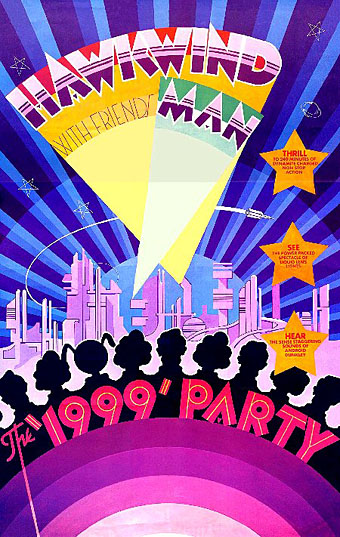
During that excellent dinner, I also discovered that HarperCollins editor Julia Wisdom’s first rock concert was seeing the British Heavy Metal band Hawkwind, who also happened to be one of my all time favorite bands, as well as that of Ian Rankin. Over the meal, Wisdom and I discussed the merits of Heavy Metal and Hawkwind’s psychedelic brand of space opera, especially their ground-breaking 1973 concept double album, Space Ritual, which was recorded live in London and Liverpool in December 1972. This album is an astounding mesh of science fiction, drugs and heavy rock and features writing from British SF writer Micheal Moorcock, as well as poet Robert Calvert and the whole Hawkwind entourage, including Lemmy who was a.k.a. Ian Kilmister who later formed Motorhead.

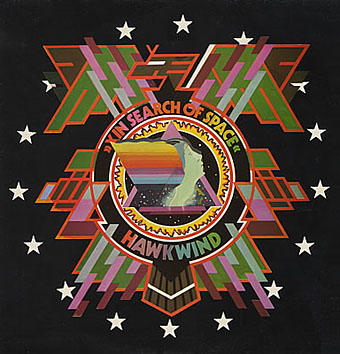
So with Hawkwind in my mind currently; I am pleased to announce that Reasons to be Cheerful (Adelita) by Paul Gorman is being released next month in the UK. It celebrates the short life of graphic artist Barney Bubbles who helped design the covers and imagery of many Hawkwind albums including Space Ritual and the definitive In Search of Space. Bubbles also designed graphics that Hawkwind used in their concerts. But Bubbles worked with many other British acts, and the title of Gorman’s book relates to the iconic Ian Drury and the Blockheads single of the same name.

It seems Bubbles made the transition from Hawkwind’s brand of SF Heavy Metal to the raw pulse of the emerging British Punk rock scene, reports The Sunday Times:
Soon Bubbles was designing record covers for Hawkwind, an explosion of ideas that pushed their freeform space-rock into a new dimension. The 1971 classic X in Search of Space, which unfolded into the shape of a cruciform hawk, was an elaborate triumph of sci-fi nouveau. “It was in the days of LSD, and I think Barney used to take the odd acid tab when he was doing the sleeves," laughs the Hawkwind co-founder Dave Brock. “You can probably see the results of that in his artwork, like Space Ritual.” Indeed, with its sleeve panels of cosmic embryos, nipple planets and sonic waves, Space Ritual combined Bubbles’s ideas on philosophy, theatre and art. Still he refused to sign his work, though his reputation was growing apace.

By the mid-1970s, Bubbles made the transition from hippie to punk, reshaping [
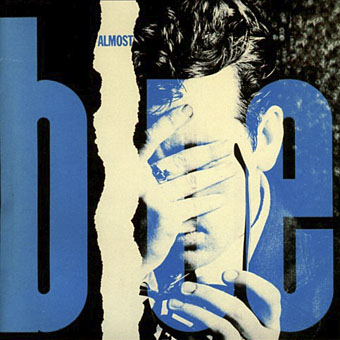
New Musical Express] NME’s logo and landing a job as in-house designer at Stiff Records. His graphics gave the fledgling label a sharp, smart new identity. He created sleeves for Nick Lowe, the Damned, Ian Dury, Elvis Costello and more — many of which cleverly subverted art movements such as dada and constructivism. It was a fiercely intelligent streak he carried through to F-Beat, Radar and Go! Discs. “His sleeve work was sensational,” asserts the Stiff photographer Brian Griffin. “And his work rate was phenomenal. I never saw Barney sleep, ever. Hit Me with Your Rhythm Stick is one of the great art pieces of the 20th century. It’s mind-blowing. I think it’s up there with a Picasso painting.”
You can see some of Bubbles’ work from Word Magazine here. However, like many creative people, Barney Bubbles was a troubled soul who tragically ended his life, here reported by Mark Paytrees at the Hawkwind fan site Starfarer:
Barney was struggling. The regular outlets for his work were drying up. He was underpaid for the work he was still doing, and a love affair crumbled around him. "I used to do this magazine with him called Y," recalls Brian Griffin. "And one day we had this argument about the rude words in the text. It was the only argument we ever had. I went round to see him and patch it up, and he'd lacerated his face with a razorblade." Nik Turner also witnessed a more desperate Barney around this time. "I got a call from his girlfriend, who said, 'Come round and help us, Barney's threatening everyone with a knife.' I did and he said, 'Look, I'll kill you too.' Then he threw the knife on the ground. He was having a nervous breakdown. Soon afterwards, he committed himself to a hospital."But Barney never recovered. "He phoned me up on the morning he committed suicide," Griffin remembers. "He said, 'Beej, I really feel terrible.' I recall him being worried about his VAT. I said, 'Don't worry, after I've finished shooting this Echo & The Bunnymen video I'll come straight over.' I finished early, mid-afternoon, and I phoned up. But it was too late. His sister came to the phone and said, 'Barney's killed himself.'"

Labels: ,

Thursday, November 20, 2008

Costa Male

Having an awards list from Costa Coffee seems apt when you consider that strong coffee is what you need when faced with a novel that refuses to be put down. The BBC reports that the big issue with this year’s awards is that the shortlist for best novel is all male:
De Bernieres has been nominated for his book, A Partisan's Daughter, which judges described as “an elegant love story about the lies we tell ourselves and why we have to”.

The Other Hand by Chris Cleave tells the story of three young characters, including Little Bee, a 16-year-old refugee from Nigeria, and how their lives intertwine. The book was inspired by the author's early childhood in West Africa and a visit to a detention centre in Essex.

Trauma by Patrick McGrath is described as a “riveting read”

And Sebastian Barry’s The Secret Scripture is about an elderly character approaching her 100th birthday.
There are five categories in all, the others being poetry, biography, first novel and children's. Each category winner receives £5,000.

The overall winner receives £25,000 and will be announced on 27 January, 2009.

Personally I was delighted to see Man Booker longlisted and CWA Dagger winner Tom Rob Smith shortlisted for Best First Novel.

Best Novel Award
  • Sebastian Barry, The Secret Scripture
  • Chris Cleave, The Other Hand
  • Louis de Bernieres, A Partisan’s Daughter
  • Patrick McGrath, Trauma
First Novel Award
  • Poppy Adams, The Behaviour of Moths
  • Sadie Jones, The Outcast
  • Jennie Rooney, Inside the Whale
  • Tom Rob Smith, Child 44
Biography Award
  • Diana Athill, Somewhere Towards the End
  • Judith Mackrell, Bloomsbury Ballerina
  • Sathnam Sanghera, If You Don't Know Me By Now
  • Jackie Wullschlager, Chagall
Poetry Award
  • Ciaran Carson, For All We Know
  • Adam Foulds, The Broken Word
  • Kathryn Simmonds, Sunday at the Skin Launderette
  • Greta Stoddart, Salvation Jane
Children’s Book Award
  • Keith Gray, Ostrich Boys
  • Saci Lloyd, The Carbon Diaries 2015
  • Michelle Magorian, Just Henry
  • Jenny Valentine, Broken Soup
According to The Independent:
The Costa judges whittled 616 submissions down to 25 books. Known as the Whitbread before it was taken over by the coffee chain in 2006, the competition is unique in bringing together adult and children's fiction as well as biography and poetry.

The overall winner will be announced in January and will receive £25,000.
The youngest contender is the Liverpool-born Jennie Rooney, a 28-year-old lawyer who completed her first novel Inside the Whale during lunch breaks from her legal practice. She will find herself competing in the first-novel category against Sadie Jones, daughter of a Jamaican poet, Evan Jones. Sadie Jones's debut, The Outcast, set in post-war suburban England, has already been shortlisted for the all-female Orange Prize. The only man to make it on to the first-novel shortlist is a former screen writer, Tom Rob Smith, whose Stalinist-era Child 44 was described as "unputdownable".

This year's judges include the author Lisa Jewell; the actress and writer Pauline McLynn; the journalist and broadcaster Michael Buerk; the poet Roger McGough; and the writer Victoria Hislop. A final panel of judges, to include a member of the book-reading public, will be announced next month.
While The Guardian’s coverage includes asking some of the shortlisted authors what they would do with the money. (Charity, says Tom Rob Smith. Lollipops for his children says Sebastian Barry.)

Labels: ,

Wednesday, October 29, 2008

Morgan on the Failure of Capitalism

I’m a big follower of the work of Gumshoe nominated Richard Morgan, having known him since he debuted with Altered Carbon. Morgan was recently interviewed at the SF Web site IO9 and his insight is always of interest, especially in these economic meltdown days.

I was intrigued at Morgan’s response to Alex Carnevale’s question relating to Morgan’s take on the economic situation and what he had written in an earlier novel:
Market Forces was a screenplay and you picked it apart for a novel. It's eerily prescient -- what does it have to say about what's happened with the economy?

I'm kinda torn because on the one hand it's always nice to be right. On the other hand, I own a house like everybody else. And I don't want to see its value drop by a third. I am constantly perplexed by the reaction to Market Forces, especially the reaction in America. I didn't really think I was saying anything startlingly off the wall. To me it seemed like I was extrapolating a fairly obvious line. Anyone who knows anyone who works in high-risk financial institutions. Anybody who has friends who are merchant bankers, or stockbrokers or commodity dealers or has anything to do with that world will tell you, and I had a number of e-mails of people saying this, this is how these people operate. It's a high-testosterone environment. These people thrive on risk and massive fast success. It's a self-reinforcing loop. The more successful you are, the more testosterone you build, and the bigger risks you're prepared to take. Inevitably you're heading for a crash with that, it's impossible to sustain.

The book was really written as a critique not so much of the systems but of the mindset of this kind of boorish American business model asshole machismo. I didn't really think I was saying anything spectacularly unusual. I thought anybody who looked at would say, "Oh. Yeah, that's right." I ran into an awful lot of people for whom market forces are a kind of religious faith. I hate to caricature, but I do think American culture has a faith problem in the sense that there's much more of a willingness on that side of the Atlantic to take things on faith, and just accept stuff and believe in something wholeheartedly.

In Europe people just seem to be a lot more cynical about these things, whatever it may be, if it's religion or politics or whatever. And yet it would appear there are a lot of people for whom free markets are tantamount to a kind of religious faith. And by writing the book I'd stomped on that as if I had written a viciously anti-Christian satire. That may be it, I don't know. It may be that it was a book in which it's hard to sympathize with everybody because the characters are all fairly unpleasant.

As for what's happened now, I can just say, "Yep, see." It's not a very emotional "Yep, see," because to me it doesn't take a whole lot of smarts to predict something like this.
Read the full IO9 interview here and there’s more from Alex Carnevale here in “Novelists Write Our Way Out of The Financial Crisis” or stick around IO9 with Meredith Woerner and get really depressed when you discover “Why the Economy is to Blame for More Night Rider.”

Photo of Richard Morgan (left) and Ali Karim taken around the time Altered Carbon was first released. Photo courtesy Ali Karim.

Labels: ,

Friday, October 03, 2008

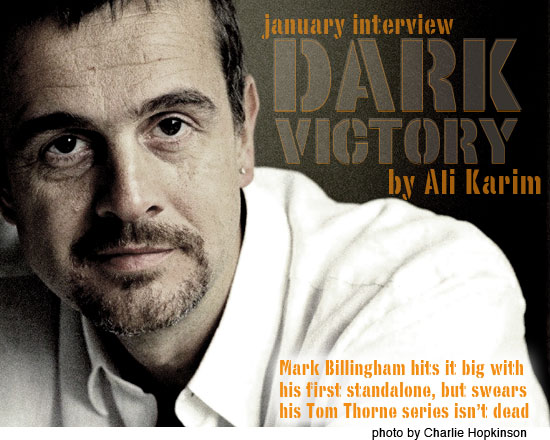
Interview: Mark Billingham

In a January Magazine exclusive interview, contributing editor Ali Karim sits down with British crime fictionist Mark Billingham (In the Dark, Death Message) and asks why the author has decided to take a break from police procedurals, how he took to composing a standalone novel and how he constructs credible dialogue. Says Karim:
Mark Billingham is a very interesting writer. That’s true not only because he’s one of Britain’s most sought-after stand-up comedians (though his act can be somewhat R-rated in places) and has also worked as an actor, but because he launched right out of the gates with a strong and astonishing debut novel called Sleepyhead (2001). That book heralded the start of a major London-based police procedural series featuring Inspector Tom Thorne and his team of inner-city cops. There have since been half a dozen additional Thorne novels, the most recent being last year’s Death Message, which showed that text messaging can have a decidedly dark side.
The full interview is here.

Labels: ,

Sunday, August 03, 2008

Rushdie and the Law

Sir Salman Rushdie has been in the press rather a lot lately. His novel The Enchantress of Florence has been nominated yet again for a Man Booker Prize marking its spot on the controversial longlist. The shortlist will be announced at the beginning of September with the winner being awarded on October 14th. Rushdie is likely a favorite for the award, as last month he was awarded the Best of the Bookers for 1981’s Booker winner Midnights Children. I read last week that Ex-Special Branch detective Ron Evans mentions Rushdie in a negative manner in his autobiography On Her Majesty's Service which is due for release shortly. One of the negative comments alleges that the team of protection officers nicknamed Rushdie “Scruffy” as we reported here last week.

This has reportedly enraged the well-known author, especially as the story has spread like wildfire from traditional print media -- in this case The Telegraph -- into the blogsphere, as reported by the Guardian, who devoted the whole of its page two on the matter under the headline “‘I was never called Scruffy’ -- Rushdie set to sue over former bodyguard’s claims:”
Ron Evans, the book’s author, claims Rushdie was imprisoned by his guards who “got so fed up with his attitude that they locked him in a cupboard under the stairs and all went to the local pub for a pint or two. When they were suitably refreshed they came back and let him out.”

The author was alerted to the claims by a newspaper story about the alleged cupboard incident last weekend, which has subsequently been picked up on
websites and blogs.

Rushdie said: "The simple fact of the matter is that nothing of this sort happened. My relationship with my protection team was always cordial, certainly entirely professional. This kind of absurd behaviour never occurred. There are three references in his article to drinking on duty - it is absolutely forbidden for police officers, particularly in possession of firearms, to drink on duty. They did not do so.

"The idea of them raiding my friend's wine cellars then me asking them to pay for this is completely fictitious. It is absurd the idea that they would lock me in a cupboard and go to the pub.

“It is like a bad comedy. My relations with the protection officers were cordial and I am still friendly with a few of them. At the end of my nine years of protection they held a reception for me. I had a lot of sympathy and understanding from the police. Our relationship was the exact opposite of what has been written. I never heard myself called by the name Scruffy in nine years.”

Read more about why Rushdie is employing lawyers to prove his name that he was never referred to as “Scruffy.”

Labels:

Wednesday, July 30, 2008

Rushdie or “Scruffy”?

After reporting that Salman Rushdie was awarded the Best of the Bookers this month for 1981’s Booker winner Midnights Children; I was amused to read that Ex-Special Branch detective Ron Evans writes less flatteringly about the award winning author in the UK Telegraph:
In his autobiography On Her Majesty's Service, Evans paints an unflattering picture of Rushdie as tight-fisted, rude and arrogant, and claims the team of protection officers nicknamed him Scruffy because of his unkempt appearance.

He said the protection team were expected to pay him rent for their sparse lodgings in a safe house, and were on one occasion confined to their rooms so Rushdie -- codenamed Joe -- could spent an intimate evening with girlfriend and later third wife Elizabeth West.

Evans was assigned to armed protection duties in 1989, when the controversial author, now 61, wrote the Satanic Verses, which was condemned for its allegedly blasphemous depiction of the Prophet Mohammed and banned in India, Pakistan, Egypt and Saudi Arabia.
The revelations make for amusing reading especially when they locked Rushdie in a cupboard and went to the pub. The Telegraph piece is here.

Meanwhile, Rushdie has been nominated for yet another Man Booker. (This time for The Enchantress of Florence.) You can see that longlist here. The shortlist will be announced at the beginning of September with the winner being awarded on October 14th.


Labels: ,

Sunday, July 27, 2008

King’s Short Treats

As someone who is surrounded by books, I have to prioritize my reading carefully. Unfortunately some books get left behind on my To-Be-Read pile when a favorite author’s work arrives on my doorstep.

One writer whose new releases automatically leap to the top of my TBR pile as soon as the postman calls is Stephen King. I have collected his work since I was an adolescent and was amused to see how much his older works are worth because, according to Books and Magazine Collector, he is the third most collectable author in the United Kingdom. The new issue Books and Magazine Collector devotes a lengthy section to collecting Stephen King first editions.

While at the Harrogate crime fiction festival earlier this month, I was graciously invited to celebrate Peter Robinson’s 21 years of Inspector Banks at a cocktail party hosted by Hodder and Stoughton, Robinson’s British publisher. While sipping chilled chardonnay with Robinson, we remarked at how fortunate we had both been when at a party specially organized by the same publisher to celebrate Stephen King’s release of Lisey’s Story back in 2006, King himself had come over to talk to us. It had been a very special moment, during which we discovered that King is a fan of Robinson’s Alan Banks series. I also discovered that I lost the ability to speak coherently in the presence of King.

I have been recently enjoying more from King than I had expected; after Lisey’s Story we had the “lost” Bachman book Blaze. Earlier this year we had the wonderfully creepy Duma Key. This fall we can expect another King work, a collection of short stories called Just After Sunset. The Hodder and Stoughton team know of my fascination for all things King and were kind enough to send me a proof volume of his new collection containing four of the stories as well as a new introduction and afterword from King himself. Just After Sunset is the fifth collection of short stories from King. It collects work that has been published at various publications in the past.

The sampler sent to me contained four stories that I hadn’t read, so to celebrate this treat considering that the weather was so good this weekend, I took out a bucket of ice into my garden and filled it with bottles of beer, and put on my reading glasses, seated myself on a reclining chair and read through the samples. These are my thoughts:

“Willa” is a creepy little story about the victims of an Amtrack rail crash in a small town in Wyoming. While the passengers wait for a recovery train to take them away from the station that they appear stranded upon, David searches for his fiancé, Willa, who has left the station and gone to a bar in town. The premise of this story is signposted early on, but this doesn’t detract from the tale because it really is an examination as to the continuity of life after death. Willa is an interesting tale of love, and how it may remain alive after death.

“The Gingerbread Girl”
is a full blown Stephen King horror novella and one that makes the pages fly by as it is a tense tale of survival and madness. Emily and Henry are a loving couple whose relationship disintegrates after their infant child dies. To cope, Emily takes up running, not just jogging, but serious running at every possible opportunity. She leaves her husband and moves into her Father’s beachside holiday home, where she encounters a serial sex-killer and finds that perhaps her running has got her into deep trouble; trouble that could cost her life. However, Emily is not a quitter and perhaps something in her ability to run may save her life. Part horror, part chase thriller, and part a peak at how people cope with grief, this little tale packs a satisfying punch. Reminiscent of
Gerald’s Game in terms of style and motivations.

“Mute” was my favorite story from this samplerr. A morality tale about a traveling salesman who picks up a mute and deaf hitchhiker and passes the time by telling him about how his wife left him for an older man, and how she left him in debt and with a compulsion to buy underwear and lottery tickets. This is a throwback to King’s early style, more pulp than literary, and bloody great fun with a killer ending -- literarily.

“Ayana” is somewhat like “Willa” in that it is also an examination of what may happen between the transition between life and death. When a young girl passes a healing touch to an old man dieing of pancreatic cancer, a chain of events occurs that may indicate that life is far more mysterious than the death that awaits us all. A haunting tale that lingers in the mind.

I would add that I enjoyed previously “Stationary Bike” which was released as an audio novella as well as the post 9/11 novella “The Things They Left Behind.” But as for the others, I’ll have to wait for November to read them all. However from reading this quartet of samples, I know the wait will be well worth it.

But if waiting until November for these stories seems unbearable, why not read one of them online at The New Yorker. The publication here offers up “Harvey’s Dream” from 2003.

Labels: ,

Wednesday, July 16, 2008

Barclay 1, Potter 0

I got in a spot of bother with a post about Harry Potter last year, from which you can gather I have probably been struck off J.K. Rowling’s Christmas card list. However I am definitely a fan of the United Kingdom’s currently bestselling book: Linwood Barclay’s No Time for Goodbye. I am pleased to see that, despite having Harry Potter and his cabal of friends making a nuisance of himself in the UK book charts, Canadian Linwood Barclay has seen off the pesky schoolboy wizard, as reported by The Bookseller:
Linwood Barclay’s No Time For Goodbye (Orion) has retained top spot for a second week with a 56,291 weekly sale, up 2,354 week-on-week. Barclay achieved the feat despite competition from the paperback release of Harry Potter and the Deathly Hallows (Bloomsbury), which became the fastest selling book of all time upon its release in hardback last year.

The children's edition of J.K. Rowling’s seventh Harry Potter instalment sold 37,644 copies through the market at an average selling price of just £1.96 - 78.2% off its £8.99 r.r.p.
Note that neither Orion Publishing or Linwood Barclay didn’t need the heavy -- and in some cases suicidal -- discounting that Bloomsbury and Harry Potter enjoy. However in fairness, Barclay does owe a great deal to having his UK debut being selected as a Richard and Judy book.

Labels: ,

.