Thursday, November 15, 2012

Crime Fiction: Lehrter Station by David Downing

A classic cat-and-mouse game -- except it’s no game. David Downing’s latest novel, Lehrter Station (Soho Crime), chronicles days full of promise, punctuated by nights full of peril, in a nation emerging from war and pulled in many directions at once.

November 1945. World War II has ended, and people on both sides of the conflict struggle to put the events of the previous five years behind them and rebuild their lives. In London, journalist and freelance spy John Russell is on the move again, trying to piece together the remains of his own life with his German girlfriend, the actress Effi Koenen. But his plans take an unexpected turn when he is tracked down by Yevgeny Shchepkin, a Soviet NKVD agent he has worked with in the past, and who lays claim once more to his clandestine services. Russell had made a Faustian bargain to secure his family’s safety, based on his promise to work for Moscow again sometime in the future, and now that bill has come due.

So Russell returns to Germany with Effi, but not before striking a deal with the Americans to work as a double agent. Aware of his previous dealings with the Russians, the Americans are skeptical: where do Russell’s real loyalties -- if he has any -- lie?

For her part, Effi hopes to revive her stalled acting career in post-war Germany, but like her partner, her wartime past dogs her, and she must wrestle with the occupation powers to prove she was not a Nazi collaborator. Neither of these characters, though, is prepared for the tensions that are emerging between the occupying powers, or for the shadowy culture of post-war Germany on the street level, where deceit and treachery are the order of the day. Russell will weave his way between black-marketers and refugees on the run, European Jews headed for a new homeland and ex-Nazis also scurrying for the safety of a new life. It is a rich storytelling mixture, and reveals the full measure of the turmoil of war.

Lehrter Station effectively captures the trauma of a defeated and dislocated people, some of them good, some bad, all trying to make their way in an uncertain world. Relying heavily on the back story of Downing’s four previous novels in this series, Lehrter Station is an evocative, penetrating account, impeccably researched, revealing the author’s trademark meticulous attention to detail. It will appeal to fans of serious fiction about the chaotic days following the end of the Second World War, as well as to those simply in search of a cracking good read. ◊

Jim Napier is a crime-fiction reviewer based in Quebec. His book reviews and author interviews have been featured in several Canadian papers as well as on such websites as Spinetingler Magazine, The Rap Sheet, Shots, Reviewing the Evidence and Type M for Murder. Napier also has an award-winning crime-fiction site, Deadly Diversions.

Labels: , ,

Friday, July 02, 2010

Crime Fiction: Potsdam Station
by David Downing

(Editor’s note: The following review was submitted by Mike Ripley, a British novelist, critic and columnist with the Webzine Shots.)

For John Russell the Second World War ends this month with the publication of Potsdam Station (Old Street Publishing UK), the fourth novel in three years from Englishman David Downing and the final part (if so it turns out) of a quartet of historical thrillers which has resulted in Downing being ushered by the critics into the same First Class compartment as John le Carré, Robert Harris and, perhaps most accurately, Alan Furst.

John Russell, for those readers who have not yet experienced Downing’s Station Quartet, is a journalist of English-American parentage who, in the early months of 1939, is a member of the foreign press corps in Berlin. As if that wasn’t stressful enough, Russell has a German ex-wife (now married to a Nazi party man), a young son raring to join the Hitler Youth and a mistress who is a rising star of the German film industry, now controlled by a certain Josef Goebbels -- all of which mean that he, unlike many of his fellow foreign correspondents, has strong personal reasons for staying in Berlin, even though war is clearly inevitable.

This is how the reader meets John Russell in Zoo Station (2007), the first installment in Downing’s quartet of thrillers named after Berlin railway depots -- and the spider web of train track, the stations where people arrive and depart, the chaos of the marshaling yards and the sinister boxcars heading eastward, all provide a central and powerful image throughout the series.

Given the place and the time, and the fact that he has press credentials, Russell, unsurprisingly perhaps, finds himself a very suitable candidate for recruitment as a spy. Although he does not actively go job-hunting, he is a known left-leaning reporter (certainly no apologist for the Nazis) and in his youth was an active communist sympathizer. Naturally, Soviet Intelligence comes recruiting with an offer he cannot afford to refuse. Then so do the British and eventually the Americans, and even the Nazis!

So, as often happened in real life, journalist turns spy and enters the very murky and dangerous world of double- and treble-cross, though no one is left in any doubt that Russell’s real loyalties lie with human beings, not countries or ideologies.

Silesian Station (2008) takes Russell’s story up to the outbreak of war in September 1939, his life one long balancing act as he struggles to protect his actress girlfriend, Effi Koenen, and his son, Paul (the former of whom has become increasingly conscious of the fate of Germany’s Jews, while the latter shows a boyish enthusiasm for Germany’s victorious armies), and also satisfy the demands of the four different intelligence agencies that think he is operating as their agent.

The biggest balancing act of all, though, is the ever-present struggle between Russell’s conscience and his instinct for survival in an increasingly unstable world. As an Anglo-American, he gains some protection from citizenship of a non-belligerent country, but as 1941 draws to a close, all of that is about to change.

Stettin Station (2009) continues the story, opening on November 17, 1941 -- the day the Imperial Japanese Navy sailed en route for Pearl Harbor and infamy, though of course none of the characters in the book have any idea of this or how it will affect their lives and the entire course of the war. With Effi taking more and more risks by defying her employers at the Propaganda Ministry and Russell’s own position both as a journalist and a spy increasingly under threat, the couple finally decide they have to leave Berlin and make a run for it. Only Russell makes it out safely, though; Effi is forced to go underground in the city, which will become a prime target for Allied bombing and eventually a prize determined to be claimed, whatever the cost, by the Russian army.

Downing’s brand-new book, Potsdam Station, takes up the saga in April 1945: Adolf Hitler’s Reich is imploding, Berlin is in ruins and the Red Army is closing in fast.

Russell has not seen or been able to contact his beloved Effi or his estranged son for more than three years, but both are alive and still in Berlin, though far from safe: the teenage Paul serving in an anti-aircraft battery, Effi living under a false identity and now actively involved in the anti-Nazi resistance.

Once he learns that the Americans and British will leave the taking of Berlin to the Russians, Russell is frantic with worry, having no illusions about the treatment awaiting German prisoners and female civilians at the hands of their vengeful conquerors. He flies to Moscow in an attempt to have himself “embedded” (as we would now say) as a journalist with the advancing Soviet war machine, knowing that his request is something of a long shot. It is, but by striding into the offices of the NKVD and demanding to see his former Soviet “handler,” Russell wins his chance.

He will be allowed to enter Berlin, not with the Red Army but actually ahead of it, and to search for Effi and Paul, but only after he has helped a Soviet team secure scientific papers from a Nazi research center -- highly secret documents which will help Russia’s atomic research. Therein lies another balancing act of conscience for Russell -- providing, that is, he survives the parachute drop into enemy territory, Allied bombing, Russian shelling and the NKVD hit man with orders to leave no loose ends.

Meanwhile, son Paul, now totally disillusioned, shuffles through the ruins of the city avoiding die-hard Nazi fanatics who pose more of a threat than the Russians, whilst Effi dodges bombs and the Gestapo with a precocious young Jewish orphan girl in tow.

All of this sets up a thrilling climax and Downing does not disappoint. But is the end of Potsdam really the end of the Station series? Without giving too much away, the John Russell/Effi Koenen (and their extended family) saga is left tantalizingly open-ended. More books are possible, I suppose, but they could not re-create the wartime Berlin setting which has made this quartet so memorable.

That David Downing knows his stuff is not in doubt. In addition to his fiction, he has also written Sealing Their Fate (2009), an excellent popular history of World War II that covers the 22 days it took the Japanese fleet to sail from its home waters to attack Pearl Harbor. His skill as a novelist is not in doubt either, after the Station Quartet. Downing’s grasp of atmospheric historical detail is amazing, quite as impressive as that of Alan Furst, and he plots his way through the convoluted byways of espionage with the confident tread of a Len Deighton or a John le Carré.

Downing can also handle a large cast of characters without resorting to two-dimensional stereotypes, and he boasts a sympathetic eye for people trying to behave decently in indecently violent situations. In Potsdam there are heart-wrenching scenes involving the orphan Jewish girl Effi Koenen -- herself on the run -- takes under her wing.

Because of the period and the Berlin setting, Downing’s quartet will inevitably be compared to Philip Kerr’s brilliant Bernie Gunther books. They are just as good, but different. Whilst Kerr opts for a private eye in the Chandler mold as the driving force of his plots (and their narrative voice), Downing is more in the classic spy-writing tradition, emphasizing the human cost of espionage, though coincidentally both series actually avoid the main years of front-line fighting, 1941-45.

The other comparison which springs to mind is Len Deighton’s Cold War trilogy Game, Set and Match and I have no difficult dropping Downing’s name in among such exalted company.

Is it necessary to read the Station books in order -- Zoo, Silesian, Stettin and Potsdam? My instinct is to say “no,” for each book is totally self-contained and I actually started with the second, immediately sought out the first and couldn’t wait for the third. (In the UK the books are published by the small and relatively new publishing imprint Old Street Publishing, and TV rights have been optioned by the producers of the movies Casino Royale and The Chronicles of Narnia).

On reflection, though, my advice would probably be to stick with the order in which they were written, to get the most out of what is a remarkable body of work. And believe me, there is much to savor and enjoy here. Britain’s News of the World newspaper used to carry a strap-line which said “All human life is here,” a description which could with some justification be applied to the fantastic fictional achievement that is Downing’s Station Quartet.

Labels: , ,

Monday, August 13, 2007

Review: Zoo Station by David Downing

Today, in January Magazine’s crime fiction section, contributing editor Stephen Miller reviews Zoo Station by David Downing. Says Miller:
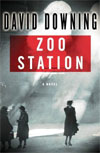
You can’t and shouldn’t judge a book by its cover, but sometimes you simply cannot help yourself. Picture a grainy black-and-white photograph circa 1940 or so. Three women are in the foreground of the image, two of them in conversation and one standing off by herself. There’s a haze that prevents us from seeing what’s in the background. Smoke? Fog? Dust in the air? Off to the left, there appears to be a Gothic church spire, but it might be something else. A torrent of light streaks across the image, upper right down to lower left, coming from the giant windows overhead. The image appears to be that of a train station, perhaps the old Penn Station in New York City or Victoria Station in London. The scene is sinister and subtle, full of secrets kept and secrets betrayed. Without reading the jacket copy, it’s clear that Zoo Station is a spy novel. And if you like your tales spiced with morally ambiguous characters right out of Graham Greene, this is a train you need to be aboard.
The full review is here.

Labels: , ,

.