Saturday, September 28, 2013

Signing an Electronic Book? There’s An App for That… Soon

PatentlyApple.com reports that the US Patent & Trademark Office published a patent application from Apple Computers on September 26th that “reveals a new iBook autographing system and more specifically to techniques and systems for embedding autographs in electronic books.” From PatentlyApple:

Book signing is the affixing of a signature to the title page or flyleaf of a book by its author. A book signing is an event, usually at a bookstore or library where an author sits and signs books for a period. Book signing is popular because an author's signature increases the value of books for collectors. The author may add a short message to the reader, called a dedication, to each book, which may be personalized with the recipient's name upon request. Book signings provide more than a just a chance to obtain signatures. Authors and bookstores are benefited by the fact that many copies of the book being promoted are sold. Signings also increase public goodwill and allow authors to connect with their fans. For fans, signings give them a chance to see and meet a favorite author and ask them questions. In order for this process to have value in the digital world, Apple has invented this new advanced autographing system.

The challenge of getting author signatures into electronic books, or across the world digitally has been looked at before. Author Margaret Atwood began developing her Longpen system in 2004. The Longpen is now being developed by the Syngrafii Corporation of Toronto, where Atwood is on the board of directors.

Labels: , ,

Thursday, September 26, 2013

Stephen King: Twilight is “Tweenager Porn”

As Stephen King’s 56th novel, Doctor Sleep, reaches a King-hungry audience, the master storyteller talks to The Guardian about, among other things, the work of some of his peers.

Stephen King, the prolific and best-selling patriarch of the horror novel, has used a rare interview to express disdain for modern pretenders to his title, dismissing the Twilight franchise as "tweenager porn" and calling The Hunger Games dull and derivative.
More predictably, King, who is about to release his 56th novel, is less than impressed by Fifty Shades of Grey, although he does have praise for JK Rowling's "fabulous" non-Harry Potter debut, The Casual Vacancy and compared her style to that of the late Tom Sharpe.
In an interview in the Guardian's Weekend magazine, the 65-year-old author said he had read Twilight, among other modern titles, out of professional interest, and had been underwhelmed. "They're really not about vampires and werewolves. They're about how the love of a girl can turn a bad boy good."
"I read Twilight and didn't feel any urge to go on with her. I read The Hunger Games and didn't feel an urge to go on. It's not unlike The Running Man, which is about a game where people are actually killed and people are watching: a satire on reality TV.

So that’s some of what he didn’t much care for. But what does he like?
King declared himself a fan of the "amazingly good" Donna Tartt, but criticised her workrate. "She's dense, she's allusive. She's a gorgeous storyteller," he said. "But three books in 30 years? That makes me want to go to that person and grab her by the shoulders and look into her face and say: 'Do you realise how little time you have in the scheme of things?' "
Scribner published Doctor Sleep on Tuesday. The long-awaited sequel to The Shining has largely drawn glowing reviews. In her New York Times review of the book, Margaret Atwood began:
“Doctor Sleep” is Stephen King’s latest novel, and it’s a very good specimen of the quintessential King blend. According to Vladimir Nabokov, Salvador Dalí was “really Norman Rockwell’s twin brother kidnapped by gypsies in babyhood.” But actually there were triplets: the third one is Stephen King.

Labels: ,

Friday, November 18, 2011

Happy Birthday to Margaret Atwood

It’s difficult to believe that the divine Miss Atwood turns 72 today. Difficult because, as we’ve said often enough in reviews and interviews, the author’s voice is as vibrant and variable now as it was 20 and even 30 years ago. One could argue that it is more so: Atwood writes with the verve of someone still pushing towards the zenith of her powers.

The Writer’s Almanac gives us some background:
It's the birthday of Canadian novelist and poet Margaret Atwood (1939), born in Ottawa, Ontario. Her father was an entomologist, and she spent a good deal of her childhood out in the woods with him as he did field work. The family moved frequently, from Ottawa to northern Quebec to Toronto, and Atwood was 11 before she attended a full year of school. She read a lot as a child, but didn't dream of becoming a writer at first; her earliest career aspirations were to the visual arts. "All writers, I suspect -- and probably all people -- have parallel lives, what they would have been if they hadn't turned into what they are," she told The Paris Review in 1990. "I have several of these, and one is certainly a life as a painter. When I was 10, I thought I would be one; by the time I was 12, I had changed that to dress designer, and then reality took over and I confined myself to doodles in the margins of my textbooks." She began writing poetry in high school, inspired by Edgar Allan Poe; by the time she was 16, she knew she wanted to be a writer.

Her novels, like The Handmaid's Tale (1983) and Cat's Eye (1988), frequently question or criticize social institutions. "I grew up in the woods outside of any social structures apart from those of my family. So I didn't absorb social structures through my skin the way many children do. If you grow up in a small town you instinctively know who is who and what is what and whom you can safely be contemptuous of."
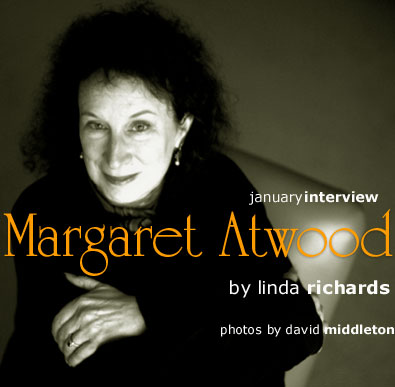
You can read January Magazine’s 2000 interview with Atwood here.

Labels: ,

Wednesday, October 12, 2011

Super Green Edition of Atwood’s New Book Available Now

Margaret Atwood, an author well known to be deeply concerned about the environment, will see a special edition of her newest book, In Other Worlds: SF and the Human Imagination (McClelland & Stewart) printed on special super environmentally friendly paper.

The paper, created by Vancouver-based Canopy, is made using with a special blend of wheat straw, flax straw, and recycled paper. From Quill & Quire:
Straw is already used to make up to 20 per cent of papers in China and India, but In Other Worlds is the first commercial book in North America to be printed on straw-based paper, says Nicole Rycroft, Canopy’s founder and executive director.
The focus here, of course, is on preserving the environment.
Currently, about 60 per cent of trees in the boreal forest in Canada’s North are logged to make paper pulp. Second Harvest paper uses straw left over from the food-grain harvest, which has significant environmental benefits.

“[Straw] uses less water, less energy, less chemicals – all around it has a much lighter footprint,” says Rycroft, adding that the 20 million tonnes of leftover straw burned after harvest each year in North America could keep some 800 million trees standing annually, if the straw were used to make paper.
Though the bulk of the print run of In Other Worlds will be on recycled paper, a special edition of 300 signed books is available directly through Canopy. At time of writing, there still appear to be copies available, but it’s hard to imagine that will continue to be the case.

In Other Worlds collects Atwood’s thoughts on contemporary science fiction. From the publisher:
At a time when speculative fiction seems less and less far-fetched, Margaret Atwood lends her distinctive voice and singular point of view to the genre in a series of essays that brilliantly illuminates the essential truths about the modern world. This is an exploration of her relationship with the literary form we have come to know as "science fiction,” a relationship that has been lifelong, stretching from her days as a child reader in the 1940s, through her time as a graduate student at Harvard, where she worked on the Victorian ancestor of the form, and continuing as a writer and reviewer.
January Magazine’s 2000 interview with Atwood is here.

Labels: ,

Tuesday, March 30, 2010

Margaret in the Twitterverse

It sounds like it could be the title of one of her very own children’s books, yet Margaret Atwood’s tales of her experiences on Twitter are as real as a cyber-experience can be. Here from The New York Review of Books blog, “Atwood in the Twittersphere:”
The Twittersphere is an odd and uncanny place. It’s something like having fairies at the bottom of your garden. How do you know anyone is who he/she says he is, especially when they put up pictures of themselves that might be their feet, or a cat, or a Mardi Gras mask, or a tin of Spam?
You can become one of Atwood’s nearly 35,000 followers here. And though January has quite a few less than 35,000 followers, we’re here.

Meanwhile, The Giller Prize’s Twitterfeed points us at an interview with Atwood for Germany’s Inspired Mind series. “Anyone who writes a book is an optimist. No matter what the content. The optimistic thing about this is: It’s a book. It hasn’t happened yet. Keep it inside those covers.”

January’s 2001 interview with Atwood is here.

Labels:

Thursday, February 18, 2010

Atwood on Optimism ... and Catastrophe

A recent CNN interview shows Canadian literary icon Margaret Atwood looking at life from both sides now. “When Margaret Atwood looks into the future,” begins the piece, “she sees catastrophe.” Which is really a smashing first line, but doesn’t have a whole lot to do with what she actually says in the piece:
“Anybody who writes a book is an optimist,” the much-honored writer says, with a dry impishness, in a phone interview. “First of all, they think they’re going to finish it. Second, they think somebody’s going to publish it. Third, they think somebody’s going to read it. Fourth, they think somebody’s going to like it. How optimistic is that?”
Throughout the article, Atwood mostly discusses her most recent novel, 2009’s spectacular Year of the Flood but, as is usual for this author, she spends some time discussing writing and writers and sharing tidbits of process:
“I have a need for a word, then I have to find the word,” she says. And it’s not always easy: “What you have to do if you’re putting a product or a corporation into a book, is you have to search and find out if there is one or not already. And if there is one already, you have to change yours so it’s not the same.” In Oryx and Crake, she says, she had created an assisted-suicide channel called NightyNight. Unfortunately, in real life, that name belonged to a children’s sleepwear company.

“You don’t want a situation in which you name an assisted-suicide television program after a children’s sleepwear company,” she says.
The CNN piece is fairly long, filled with great quotes, and it’s here. January Magazine’s 2000 interview with Atwood is here.

Labels:

Wednesday, August 26, 2009

Atwood Pulls All Stops for The Year of the Flood

According to the Toronto-based design company she worked with, Margaret Atwood wanted an extraordinary Web site to help promote The Year of the Flood, out this September from various publishers around the world.

“She has created a heightened sensibility in the book of everything in the natural world,” Scott Thornley of Scott Thornley + Company told Design Edge Canada. “She wanted a site that would represent that but she also wanted to move it beyond being just about the book.”

In The Year of the Flood we’re back in a dystopic world similar to the one Atwood created for 2003’s wonderful Oryx & Crake. But, by all accounts, the view this time is a more gentle one. From the Web site:
Adam One, the kindly leader of the God’s Gardeners -- a religion devoted to the melding of science, religion, and nature -- has long predicted a disaster. Now it has occurred, obliterating most human life. Two women remain: Ren, a young dancer locked away in a high-end sex club, and Toby, a former God’s Gardener, who barricades herself inside a luxurious spa. Have others survived? Ren’s bio-artist friend Amanda? Zeb, her eco-fighter stepfather? Her onetime lover, Jimmy? Or the murderous Painballers? Not to mention the CorpSeCorps, the shadowy policing force of the ruling powers... As Adam One and his beleaguered followers regroup, Ren and Toby emerge into an altered world, where nothing -- including the animal life -- is predictable.
The site Thornley and company created for Atwood includes several interactive elements and represents the publication of the book in Canada, the U.S. and the U.K. More countries will be added as time goes on.

But though the Web site is thorough and impressive, it’s just the tip of the promotional iceberg for The Year of the Flood. Atwood herself is tweeting, blogging (“Favourite question afterwards: ‘Is there a plot?’ Ah yes. There is always a plot.”) and has even written an hour-long theatrical performance complete with original score.
Link
The Year of the Flood Web site is here. The Design Edge Canada piece is here. January Magazine’s review of Oryx & Crake is here. Our 2000 interview with Atwood is here.

Labels:

Tuesday, April 28, 2009

Atwood at the Movies

It’s Margaret Atwood all the time this week at the National Film Board of Canada. The NFB announced yesterday that it would play an important role in bringing Atwood’s most recent book to the screen:
The National Film Board of Canada has just optioned the film rights to Margaret Atwood’s non-fiction book, Payback: Debt and the Shadow Side of Wealth. Payback is an investigation into the concept of debt as an ancient and central motif in religion, literature and the structure of human societies. The film will be directed by Jennifer Baichwal (Manufactured Landscapes) and produced by Ravida Din (Family Motel).
Perhaps to celebrate -- and certainly to highlight -- the cementing of this relationship, the NFB is currently screening Michael Rubbo’s 1984 film, Margaret Atwood: Once in August, right on their Web site. You can see the nearly hour-long film here.

Labels: ,

Friday, January 16, 2009

Atwood Classic Not Suitable For Teens?

The suitability of Margaret Atwood’s 1985 classic The Handmaid’s Tale has been challenged at a Toronto school, according to The Toronto Star.
Toronto's public school board is reviewing Margaret Atwood's The Handmaid's Tale after one complaint from a parent whose child was studying the novel in a Grade 12 class.

While the board would not discuss the nature of the concern over the 1985 dystopian novel that is used nationwide -- described by some educators as a staple of its genre – a source said it was believed to be over sexuality and criticism of religious fundamentalism.
This is apparently the first time The Handmaid’s Tale has been challenged in Canada, though it ranks 37th on the ALA’s Top 100 most frequently challenged books from 1990 to 2000.

The original article is here. In a follow up editorial, The Star’s Living columnist Antonia Zerbisias answers the challenge, saying, in part:
It's a great book and, like George Orwell’s Animal Farm, required reading for my Cold War generation, and Aldous Huxley’s timeless Brave New World, is exactly the kind of literature needed to stimulate thoughtful discussion amongst adolescents who might not otherwise debate much more than who should win American Idol.Link
Especially in times like these.

Labels: ,

Thursday, April 26, 2007

Margaret Atwood and the Defining Books of Our Era

As you might have read at The Rap Sheet, I was bowled over meeting with Margaret Atwood at The London Book Fair last week.

I dusted off my copies of The Blind Assassin, The Handmaid’s Tale and Oryx and Crake and re-read sections of them. It had been a little while since I had read Atwood so I was overjoyed, finding depth and insight in her use of language.

The award-winning Canadian Novelist is spending a little time in London, naturally because of The LBF and her work at her LongPen Company, so I was pleased to read about her take on writing in The Guardian.
The novels I finish -- as opposed to the sunnier, jollier ones I begin -- are always those that seem the most impossible when they first present themselves. I never tell my publishers what I’m writing, because -- being in my non-writing life an optimistic, Pollyanna sort of person -- I can anticipate the expressions of disbelief and horror that would come over their faces. “You're writing WHAT?” those expressions would say. Behind my back, they would whisper: “She's finally slipped a cog.”
She then tells of her experiences in writing Oryx and Crake:
I began writing Oryx and Crake in early 2001, while I was in northern Australia watching birds and talking about rare species, diminishing habitats, invasive animals, plants, and insects that are destroying native ecologies. In Australia it’s pigs, rats, cats, cane toads and rabbits; in New Zealand it’s rats, cats and possums; in the Great Lakes it’s zebra mussels, among others; in New Orleans -- at that time, before the floods -- it was exotic termites. The lists grow ever longer. Our ability to modify species and even create new ones would add to the effect.

The book presented itself to me as an almost-complete but distant structure -- one I needed to enter and explore. I set off to do that, paused while undergoing the twin towers trauma and the anthrax scare of September/October 2001, and resumed writing the novel, to publish it just at the moment when the Sars epidemic was splashing itself all over the papers, with one of its loci being Toronto, where I live. During the book tour, people ran for the door when I coughed. All the literature about the Black Death I'd read over the years seemed to be coming true. Happily, it didn't. Not that time.

Like The Handmaid’s Tale, Oryx and Crake has become truer since I wrote it. I don’t relish this phenomenon. Surely people write such books in the belief that if we see where such roads lead, we won't go there. As I’ve said, I’m an optimist. Let’s hope.
Read Atwood’s take on the writing process in The Guardian here. You can download an MP3 podcast with Margaret Atwood talking about Oryx and Crake here:

I consider Atwood as a novelist whose work helps define and explain our times, so I was even more delighted when The Guardian provided us with the excellent supplement “TimeLife: 50 Books that defined their era”. Joe Ricketts introduces this very interesting supplement:
Everyone knows that sex began in 1963, “between the end of the Chatterley ban and the Beatles’ first LP.” Philip Larkin was merely confirming the way that -- thanks to a ludicrous obscenity trial 30 years after it was written -- DH Lawrence’s novel defined an era.
This is nothing new. Books are ever-present at the conception, peak and death of decades: breaking taboos, forging cultures and countercultures, making social and scientific strides. Of course, decades are also shaped by technology, war, music, and art; but books can wrap all of these together and add something extra.


Both reading and the experience of decades are also where, to borrow another 60s phrase, the personal is political. So it is a tricky task to sort through the riches of the 20th century and name 50 books that define the decades for us all. Approach this list as a talking point rather than a definitive statement; inclusion of Germaine Greer but not Simone de Beauvoir should be enough to start debate.

This is not a bid to judge the greatest books of the century, but rather those that define their eras. Breaking a literary mould is not enough for inclusion: most of these books played a role in events or shaped society's view of itself at the time. Historical fiction has been largely pushed to one side in favour of work with period furniture, or that carries a contemporary essence in its idea of the future (Brave New World, 1984).
One area is the authors that helped define the various generations. I was most pleased to see Albert Camus mentioned next to Ian Fleming, so no literary snobbery here:
The first world war also shaped the life of Albert Camus, whose father was killed on the Marne in 1914. He became a great French author, but he came from far outside French high culture. His mother was an illiterate cleaning woman and he was born and educated in Algeria, where many of his works, such as L’Étranger [The Outsider] and La Peste [The Plague] were set.
His most famous book was distinctive of its era yet took a tangent to the times. You would know nothing directly of the second world war from The Outsider, which was first published in 1942, yet its sense of the absurd is formed by that calamity. Meursault, Camus’s anti-hero, was a new modern character, unillusioned rather than disillusioned. Recognising “the benign indifference of the universe”, the only moral purpose that an individual can find is mere truthfulness about this bleak state of affairs. Meursault is a murderer, yet he dies because he is unwilling to fake the guilt required by those who sit in judgment on him.
Camus’s philosophical work of the 1940s, The Myth of Sisyphus, begins from “the one really serious philosophical question, and that is suicide”. He had been a communist, but before his death in a car crash aged 46, he had fallen out with his former comrade Jean-Paul Sartre largely because of his growing political scepticism. Even politics did not give life significance.
So from French existentialism we have British Thriller writing holding onto a decaying Empire.
Some authors are true to their age by giving form to a culture’s enjoyable fantasies. This is what Ian Fleming did by creating James Bond in the 1950s. You might not think from Bond’s behaviour that its author knew anything of real spies, but in fact Fleming, after Eton and Sandhurst, had worked for naval intelligence in the war. Beginning with Casino Royale in 1953, he set out to write bestsellers, with a recipe well characterised by the then leader of the Labour party, Hugh Gaitskell. “The combination of sex, violence, and alcohol and -- at intervals -- good food was to me irresistible.” With their adaptation of the traditional adventure story to a modern age and their witty hedonism, Fleming’s novels were hugely influential.
From Russia With Love may make its thrills out of the cold war, but this is not what makes it distinctive of its epoch. It is rather its sophisticated belief in pleasure. Ruthless and gentlemanly, patriotic and amoral, Bond is a connoisseur of sensations, and the enviable, not entirely pleasant hero for an age. Fleming himself, posh but populist, penning his sophisticated entertainments at his retreat in the West Indies, seemed just the man to be producing these shiny international novels.
You can read more about authors who defined their decade here.

Of course you need to consider the role of the “bestsellers” that peppered the decades and shaped our view of the world. As a Crime/Thriller devotee I was pleased to read this:
Probably the biggest selling English language author of the 20 century, for instance, was one Mickey Spillane, an author of hard-boiled detective fiction. Estimates suggest that Spillane sold over 200 million books in his lifetime, most of them in the US, but plenty here in the UK too. He was hated by critics, derided by other writers. Hemingway loathed him. Fellow crime writer Raymond Chandler (another whose artistry the critics only recognised long after the public at large) described Spillane as a writing “gorilla” and said that “pulp writing at its worst was never as bad as this stuff”. What's more, Spillane himself had a pretty low opinion of his work, putting the success of his books down to the simple fact that “people like them”. By the later years of his long life, it seemed as if he was doomed to disappear without a trace, unloved and unlamented. Then a funny thing happened. His rough prose began to win recognition, the New York Times called him “a master”, a Pittsburgh professor wrote a companion to his novels, and publishers reissued his books with pleasant, brightly coloured pulp fiction covers. His reputation is stronger now than at any time during his life, and although he may not be selling in the same mind-blowing quantities, he seems set to last.
You can read the whole story here.

The supplement then publishes what it considers are the 50 books that defined our era and this list will provoke thought and interested controversy.

The complete list: 50 books that defined each decade as denoted by The Guardian:

1900s
Heart of Darkness, Joseph Conrad
The Hound of the Baskervilles, Sir Arthur Conan Doyle
Interpreting Dreams, Sigmund Freud
Kim, Rudyard Kipling

1910s
Howards End, EM Forster
The Good Soldier, Ford Madox Ford
The Penguin Book of First World War Poetry, ed Jon Silkin
The Ragged Trousered Philanthropists, Robert Tressell

1920s
Lady Chatterley’s Lover, DH Lawrence
Relativity, Albert Einstein
The Great Gatsby, F Scott Fitzgerald
The Murder of Roger Ackroyd, Agatha Christie
The Sun Also Rises, Ernest Hemingway
The Waste Land, TS Eliot
To the Lighthouse, Virginia Woolf

1930s
Brave New World, Aldous Huxley
Brighton Rock, Graham Greene
Right Ho, Jeeves, PG Wodehouse
The Big Sleep, Raymond Chandler
The Grapes of Wrath, John Steinbeck

1940s
1984, George Orwell
The Diary of a Young Girl, Ann Frank
The Naked and the Dead, Norman Mailer
The Outsider, Albert Camus

1950s
From Russia With Love, Ian Fleming
Look Back in Anger, John Osborne
The Catcher in the Rye, JD Salinger
The Day of the Triffids, John Wyndham
Things Fall Apart, Chinua Achebe
Waiting for Godot, Samuel Beckett

1960s
Ariel, Sylvia Plath
Catch-22, Joseph Heller
Portnoy’s Complaint, Philip Roth
Revolutionary Road, Richard Yates
The Spy Who Came in from the Cold, John le Carré
Valley of the Dolls, Jacqueline Susann

1970s
Carrie, Stephen King
The Female Eunuch, Germaine Greer
Zen and the Art of Motorcycle Maintenance, Robert M Persig

1980s
A Brief History of Time, Stephen Hawking
Beloved, Toni Morrison
Midnight’s Children, Salman Rushdie
Money, Martin Amis
The Bonfire of the Vanities, Tom Wolfe
The Wasp Factory, Iain Banks

1990s
Birthday Letters, Ted Hughes
Bridget Jones’s Diary, Helen Fielding
Fever Pitch, Nick Hornby
No Logo, Naomi Klein
The Buddha of Suburbia, Hanif Kureishi

There is a competition for you to vote which of these books you consider is the overall winner.
The winner and winning book will be chosen at this years Hay Festival and the winner awarded £1,000 of book tokens.

Other sections include Desert Island Books, Counterculture and a word from the sponsors of the article The Pilsner Urquell brewery. Is there anything better in life than sitting out in the sun, ice cold beer in one hand and a great book in the other?

The full supplement is available here, but where’s Margaret Atwood?

Labels: ,

.